
 Italiano
 English
Published ·
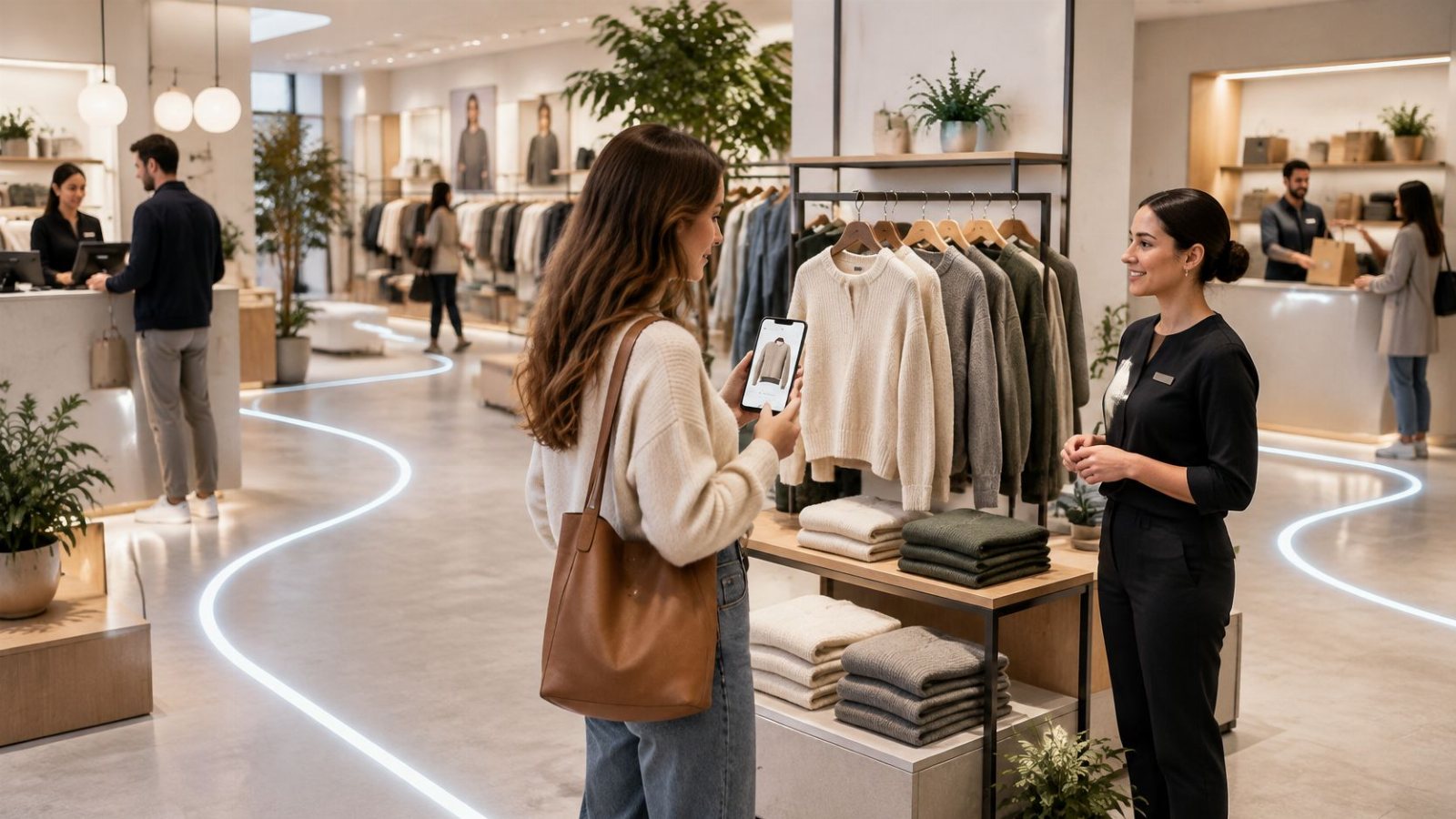
The retail customer journey is not the sum of website and store. It is the sequence of contacts the customer has with your brand, from the phone in their hand all the way to the return. Here we look at what happens between the promise read online and the physical test, and at what you can control in your own store.
Contents
- What the retail customer journey means for your store
- The stages of the journey and the touchpoints in store
- Friction and two hypothetical cases
- How to analyse the journey in four steps
- Where AI comes in and what the law requires
- What to do on Monday morning in your store
What the retail customer journey means for your store
In 2024, according to the Istat report Citizens and ICT, 46.8% of people aged 14 and over who had used the Internet in the previous 12 months bought goods or services online for private use. In the Centre-North the share reaches 50.0%; in the South it stays at 38.4%.
The figure says that digital is an ordinary stage of the journey. It does not say which contact closes the sale in your store, or whether the website only informed while the till took the money.

The retail customer journey is the chain of contacts with the brand: online search, visit, evaluation, purchase, collection, return and repurchase. The store is one stage among others, not the only place.
Picture a customer who sees a jumper on the website, tries it on in the store, orders it from her phone and collects it on Saturday. The store has followed three stages out of four, and often keeps no record of them. What she read online shapes the questions at the shelf and at the till: the staff need to stay consistent with that information.
Your store is a link in the chain, not an isolated place.
The stages of the journey and the touchpoints in store
Start from this map and adapt it to your format. A stage exists if the customer goes through it, even when nobody records it. A neighbourhood optician may have search and collection without a digital basket. A perfumery lives on advice on the shop floor.
Stages of the journey, touchpoints and what to observe
| Stage | Typical touchpoint | What to observe in store |
|---|---|---|
| Search and inspiration | website, social media, reviews, phone in front of the shelf | how many times the customer checks their phone before asking |
| Arrival and first contact | window, sign, threshold, first greeting | how long the customer stays on the threshold before coming in |
| Evaluation | price tags, trying on, staff advice | recurring questions and information missing from the shelf |
| Asking for help | floor staff, till, chat, phone | waiting time and how consistent the answer is with the website |
| Purchase and payment | till, card terminal, app, loyalty card | abandonment at the till and customers recognised or not |
| Collection and return | click and collect, returns desk | collection time, goods ready, reasons for returns |
| Repurchase and after-sales | newsletter, messages, loyalty programme | whether the customer comes back in the following months and through which channel |
For each stage, write down the real touchpoint and a single thing to observe over the next few shifts. The move from multichannel to omnichannel shows up in these steps, not in opening one more channel.
Friction and two hypothetical cases
A friction is the moment when the customer repeats information they have already given, or gets an answer different from the one they read online.
Price or availability: the website and the shelf do not match.
Invisible booking: when the customer arrives, the staff cannot find it.
Separate collection: the online order ends up in a different queue from the till.
If the same cause comes back every week, it is a system friction and calls for work on tools or processes. If it is solved within the shift, it is operational.
Two hypothetical cases
Picture a neighbourhood optician. The customer books on the website, chooses the frame in the store and asks to collect it the next day. The critical stage is evaluation: count how many times they repeat the same details before the fitting. A handover sheet, read when the customer arrives, is enough as a first step.
Picture a home and living store. The sofa seen online is on display in another fabric, and the customer asks when it will be delivered. The critical stage is asking for help. Count how many questions are about fabrics and lead times, then keep a sheet updated every week. Visual merchandising aligned with the website avoids improvised answers.
Fix first the stage where the question is repeated most often, not the one with the most traffic.
How to analyse the journey in four steps
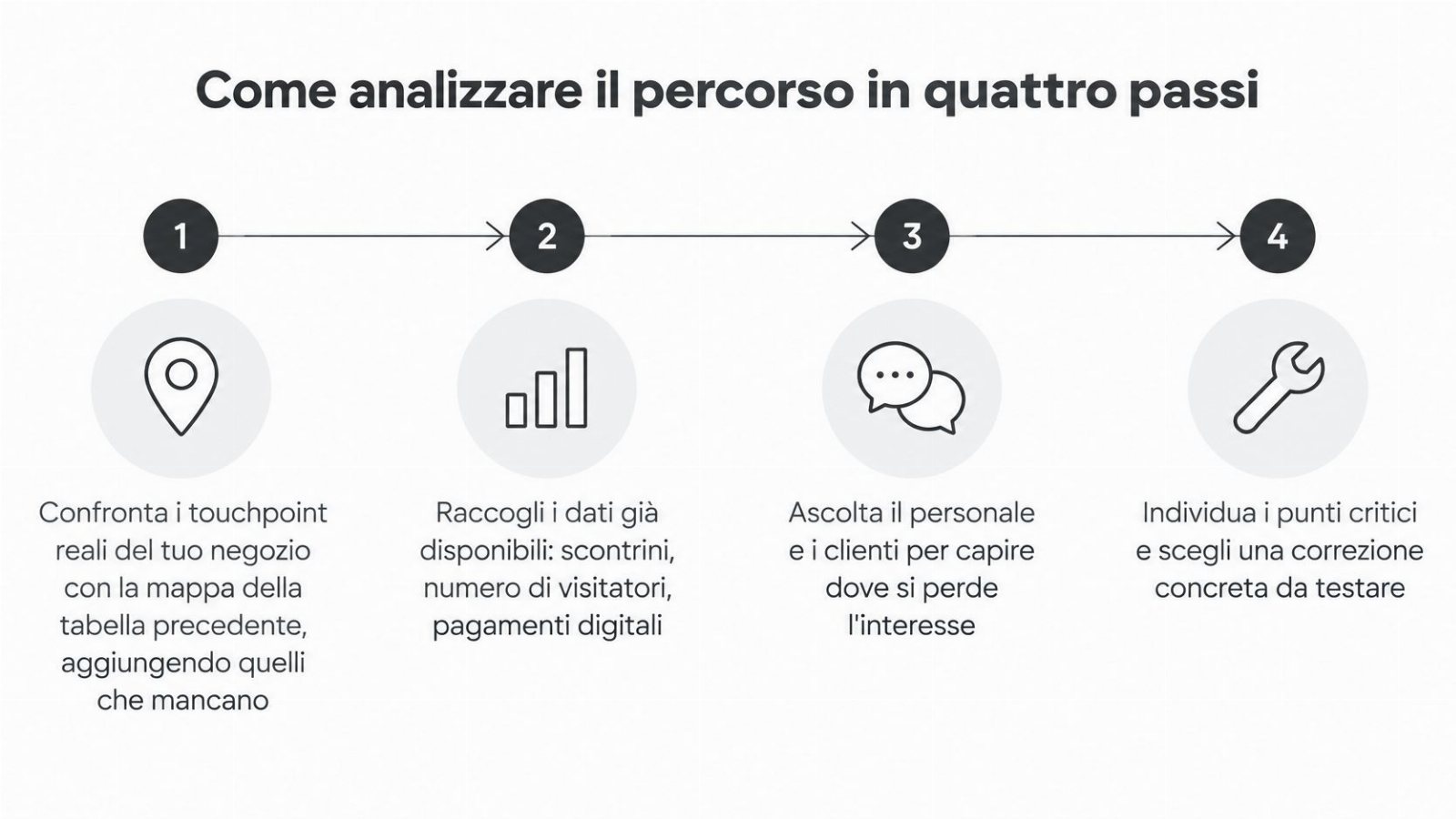
Compare the real touchpoints with the map and add the ones that are missing.
Gather the data you already have: footfall, conversion, waiting times, returns and collections.
Observe a few shifts and note repeated questions, phones in front of the shelf and sales started elsewhere that the staff pick up.
Change one thing only, then measure.
Observe, interpret, apply is the Milano Retail Tour method: first the data from the field, then the decision.
In 2025 the average OCX Index of the Politecnico di Milano Observatory is 4.4/10, and only 7% of companies are rated advanced. Having the channels is not the same as holding them together.
Indicators to measure the continuity of the journey
| Indicator | How it is calculated | Where to find the data |
|---|---|---|
| Customer recognition rate | visits with an identified customer / total visits | CRM and till |
| Online orders collected or returned in store | orders collected or returned in store / online orders | order management system |
| Customer care response time | average minutes between request and answer | request log |
| Conversion of leads generated in store | leads who buy / leads generated in store | CRM |
| Share of campaigns triggered by behaviour | campaigns started by a trigger / total campaigns | marketing automation platform |
Read them together. High recognition with slow answers points to a stalled process, not an empty customer database. An indicator is only useful if the staff know how it is calculated.
Where AI comes in and what the law requires
Retail first, then AI. The tool comes in when the friction has already been measured, not when a demo is convincing.
Writing a newsletter, summarising reviews or querying sales in plain language is not making automated decisions about a customer or an employee. The inventory tells the two cases apart: tool, data processed, authorised users, human oversight.
Since 2 February 2025, Article 4 of the AI Act requires those who use AI systems to ensure an adequate level of AI literacy among their staff. It sets no minimum hours and no single certificate. Training follows the role.
Sales: checks the answers, protects customer data, knows the limits of automated clienteling.
Management: supervises, assesses the results, keeps a record of the training.
Configuration: works on data, integrations and controls.
Data collected at the till and in the CRM remains subject to the GDPR. The rules on high-risk systems start on different dates depending on the system: check the one for your tool before bringing AI into the store.
What to do on Monday morning in your store

Pick the question customers repeat most during the week and have the staff note it down for three days.
Assign an owner to every piece of information in the journey: who updates prices and availability on the website, who checks the shelf, who answers at the till.
Align the online product page once a week with what the customer really finds in the store.
Set the date when you will reread the indicator you chose, without changing anything else in the meantime.
The journey does not end at the till, and the store only controls it in the stages it observes.
Download the free guide from our practical guides for the store.
Sources: Istat, Citizens and ICT 2024, April 2025; Digital Innovation in Retail Observatory of the Politecnico di Milano, OCX index, 2025.
Since 2011, Milano Retail Tour has been looking at stores in the field in Milan and rebuilding the journey from the window to collection, not from channel reports alone. If you want to see the frictions customers run into in real stores and bring the lessons back to yours, start from the visits and materials on Milano Retail Tour.