

 Italiano
 English
Published ·
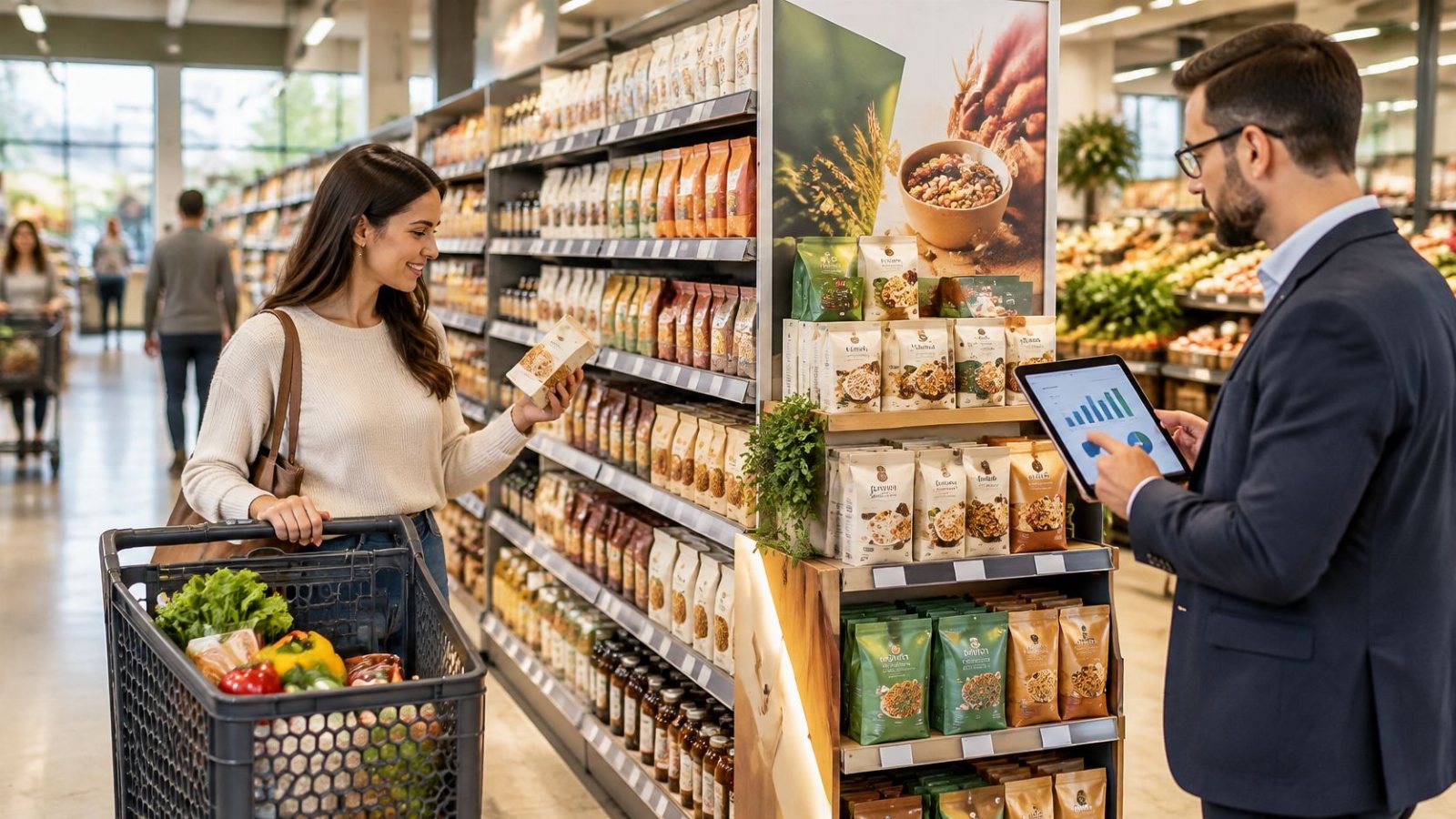
In Italian packaged consumer goods, promotional pressure went from 23.2% in 2023 to 24.5% in 2024 and levelled off at 24.4% in 2025 (GDO News, June 2025). Almost a quarter of sales still go through a discount, but growth no longer comes from adding promotions. In the same 2025, volumes in the sector rose by 2.1% and value by 3.4%, with inflation held at 1.3%.
The question that matters for anyone running a store is not how much you promote, but how much of what sells on promotion would have sold anyway. That is where trade marketing is judged: on incremental profit, not on sell-out.
Contents
- What trade marketing means at the point of sale
- Trade marketing goals and how to measure them
- Activities across sell-in, execution and sell-out
- The tools: materials, data and content
- Measuring a promotion with incrementality
- Examples from the store: food, home and perfumery
- What to do on Monday morning in your store
What trade marketing means at the point of sale
Trade marketing is the set of activities through which a manufacturer works with the retailer to influence buying behaviour in the channel and at the moment of choice. Brand marketing builds awareness outside the store. Trade marketing acts inside it: on the shelf, on the displayed price, on product availability.

A POPAI study cited in research on Italian grocery retail presented at the Marketing Trends Congress finds that at least 2 purchases out of 3 are decided directly at the point of sale (Bellini, Cardinali, Grandi, 2016). The same study, using IGD data, describes an Italian consumer who pays more attention to promotions than the European average: 43% always read the flyers (33% in Europe), 29% use coupons or discount vouchers (19%), 66% regularly compare the prices of individual products (61%), and 59% gather information before going shopping (51%).
The figure says where the purchase is decided. It does not say how much each lever weighs on a single receipt: that can only be measured in your own store, with your own numbers.
Trade marketing goals and how to measure them
| Goal | Lever in store | Main indicator |
|---|---|---|
| Increase sales of a category | shelf position, gondola end, signage | sell-out value per linear metre |
| Get customers to try a new product | tasting, sampling, staffed tester | units sold in the weeks after the activity |
| Protect the reference price | promotions limited in time and to the category | share of turnover sold on promotion |
| Improve on-shelf availability | replenishment checks, agreements on orders | out-of-stock rate |
| Build customer loyalty | loyalty programmes, staff trained to advise | purchase frequency of active customers |
Read the table vertically. A volume goal is not assessed on gross turnover but on units and on value per linear metre. A margin goal needs the average selling price, not the average discount given.
The most common mistake is choosing the tool before the goal: you start from the flyer, the tester or the loyalty programme, and only afterwards ask what was supposed to happen. The journey the customer makes between window, shelf and till remains the place to start (the retail customer journey).
One goal per quarter. One main indicator and one control indicator. Two goals at once mean neither will really be measured.
There is a borderline case to recognise: a category that grows in volume and loses value reaches its goal only halfway, and it is almost always the promotion itself that created the problem.
Activities across sell-in, execution and sell-out
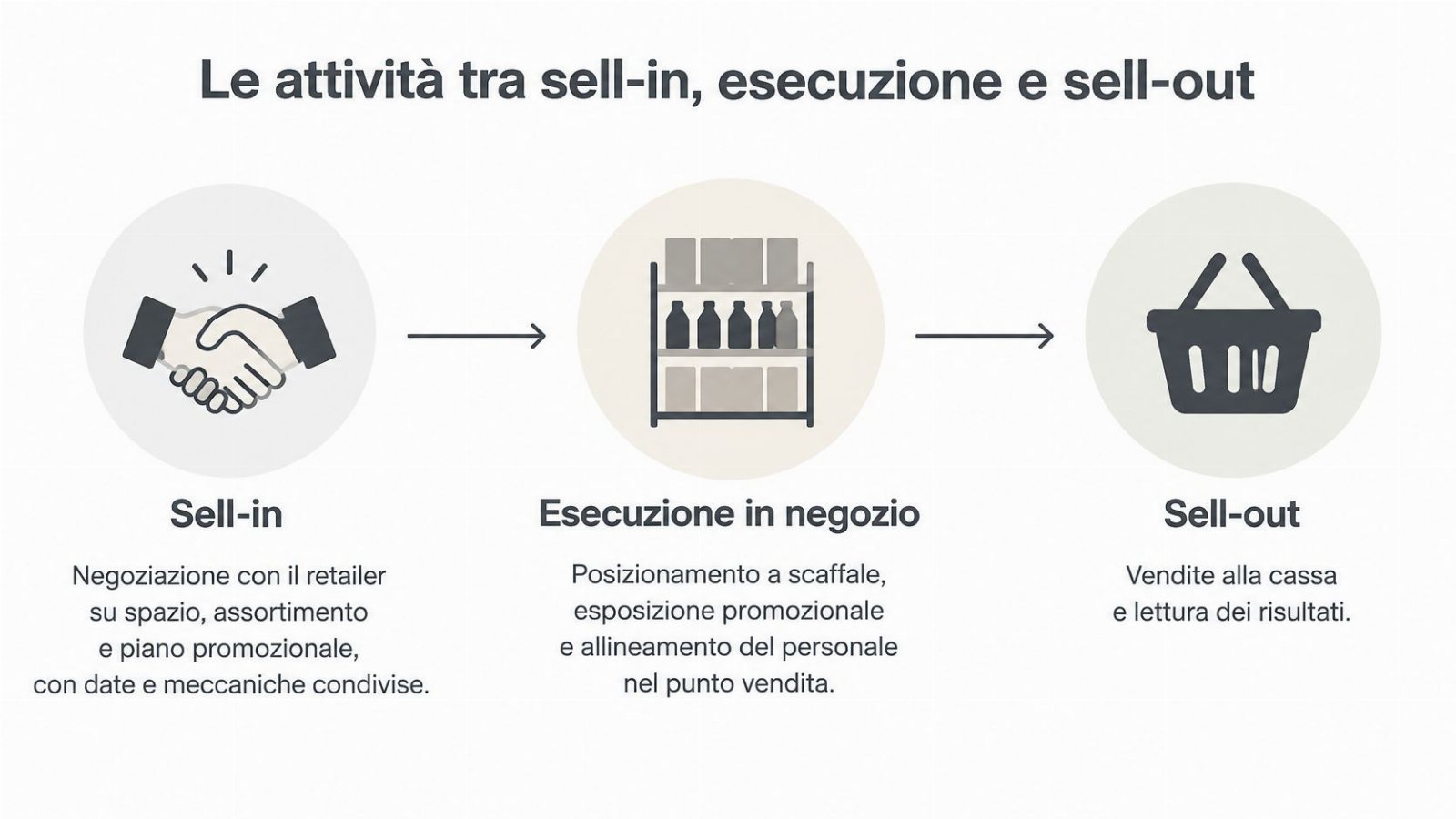
Three phases, one activity. Sell-in is the negotiation with the retailer on space, range and the promotional plan, with shared dates and mechanics. Execution is what happens in the store: planogram, shelf position, point-of-sale materials, trained staff. Sell-out is reading the results store by store, out-of-stocks included.
In food, a gondola end for a new line of preserves works if price and message can be read from the aisle. In a perfumery, a staffed tester on a Saturday afternoon is worth more than ten signs, because there is a person explaining.
This is how the three phases hold together.
In packaged consumer goods, promotional pressure reached 25.0% of sales in the first half of 2026, against 24.2% in the same period of 2025 (GDO News, August 2026). About one euro in four goes through a promotional lever, and the rise of 0.8 points says that sell-out depends more and more on discounts. In hypermarkets over 4,500 m² the share reaches 34.1%.
The mistake is treating the three phases as departments that don't talk to each other. The sell-in plan has to take into account what the shelf can actually execute, and sell-out has to tell sell-in which spaces worked.
The tools: materials, data and content
| Group | Tools | Cost of getting it wrong |
|---|---|---|
| Point-of-sale materials | displays, price signs, signage | a display that doesn't fit in the aisle |
| Planning | planograms, promotional calendar, range sheets | a promotion out of step with replenishment |
| Data | sell-out by store, receipts, customer reviews | decisions based on data that can't be compared between stores |
| Content | product pages, newsletters, social posts | an unverified claim on a product page |
Start from the problem, not from the tool. If the shelf isn't emptying, the question is whether the product is visible and available, not whether a post is missing. If the price isn't clear, the problem is the signage, not the creative. The first point is checked visually and takes three minutes (visual merchandising).
AI is also one tool among others, with a precise constraint. Since 2 February 2025, Article 4 of the European regulation on artificial intelligence requires providers and deployers to take measures to ensure a sufficient level of AI literacy among the staff who use those systems on their behalf (DSC Legal, AI Act). No number of hours is set: what is needed is documented action proportionate to the role, including for those who write product pages, newsletters and replies to reviews.
Three rules are enough: define who uses what, decide which data must not be uploaded, name who checks the result.
Measuring a promotion with incrementality
Units sold on promotion measure volume, not effect. The minimum metric is incrementality: units sold during the promotion minus the expected baseline, built on comparable stores or periods (NielsenIQ, 2022). The ratio between incremental units and total units tells you how much of the result really depends on the promotion.
| Indicator | What it measures | Limit |
|---|---|---|
| Units sold on promotion | total volume for the period | doesn't separate sales that would have happened anyway |
| Lift against the baseline | net growth across comparable stores | needs well-chosen control stores |
| Share of incremental units | part of the result due to the promotion | needs an estimated baseline |
| Incremental margin | additional profit after discount, contributions and logistics | needs reliable cost data |
The design is quasi-experimental: test and control stores, constant range and availability, with price, space, duration, footfall and out-of-stocks recorded in each. With only a few stores, you compare the same store in comparable weeks, with and without the promotion, and state that the result is less robust.
Picture a chain of three home and living stores running a discount on a line of pans: volume goes up in the promotion week, margin doesn't, because demand moved over from the following week. ROI is calculated on incremental profit, subtracting discount, contributions to the retailer, materials, logistics and lost margin, not on gross turnover. The reference price that stays on the shelf matters as much as the margin (pricing strategies).
Examples from the store: food, home and perfumery
In 2024, in-store purchases at the main Italian physical retailers rose by 2.5%, while the likelihood of recommending the same retailers' e-commerce fell by 3.8% in two years (Ipsos, Migliore Insegna 2024). The store is not a channel in retreat. But every category uses it differently.
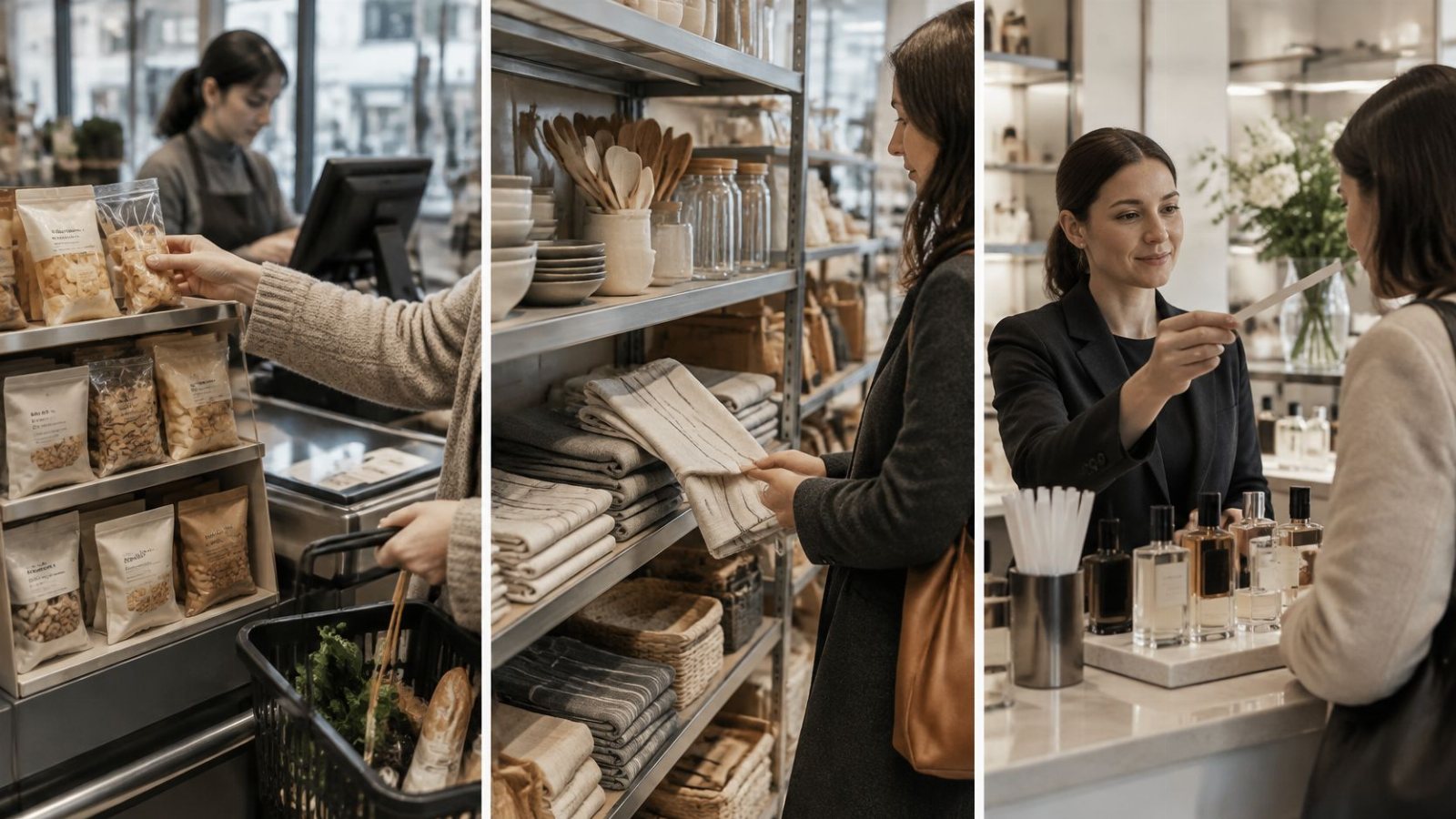
In food, the till and the gondola end capture impulse purchases: the incentive has to be readable in the first second. In home and living, value is played out on display and demonstration, with the price readable from the aisle. In perfumery, the lever is the staff: testers, advice and samples need training and someone on the floor at peak hours.
During a visit, check three things, always the same: the promotion is there, the displayed price matches the one at the till, the promoted product is available. Picture a neighbourhood optician promoting a second pair of lenses, or a pharmacy demonstrating a supplement at the counter: the department changes, the check doesn't.
What to do on Monday morning in your store
Monday is the day for measuring. High sell-out over the weekend can hide a loss-making promotion, if those items would have left the shelf anyway. Five checks in sequence turn doubt into a calculation.
- Pick a running promotion and estimate how many units would have sold without it, using the previous weeks as a reference.
- Observe the shelf in that department: is the reduced price widening sales of the category, or only moving demand away from the full-margin products next to it?
- Calculate the margin of the initiative net of discount, contributions and materials: the units sold tell you the turnover, the margin tells you the profit.
- Note the out-of-stocks during the activity and in the two weeks after, because they shift demand more than it seems.
- Compare your store for four weeks with a comparable one, or with yourself in a period without the promotion.
Since 2011, Milano Retail Tour has studied stores in the field in Milan and works on exactly this kind of check, with guided half-day or full-day visits and a closing classroom workshop on the levers you already use: you'll find the tours on Milano Retail Tour. The principle stays the same: trade marketing pays off when the shelf is measured.
Sources: GDO News, Promo più intelligenti, volumi in crescita, prezzi sotto controllo, June 2025; Bellini, Cardinali, Grandi, Trade marketing e grocery retail italiano, Marketing Trends Congress, 2016; GDO News, Promozioni, la GDO alza la pressione, August 2026; DSC Legal, AI Act e imprese, 2026; NielsenIQ, How to measure trade promotion effectiveness, 2022; Ipsos, Migliore Insegna 2024.