
 Italiano
 English
Published ·
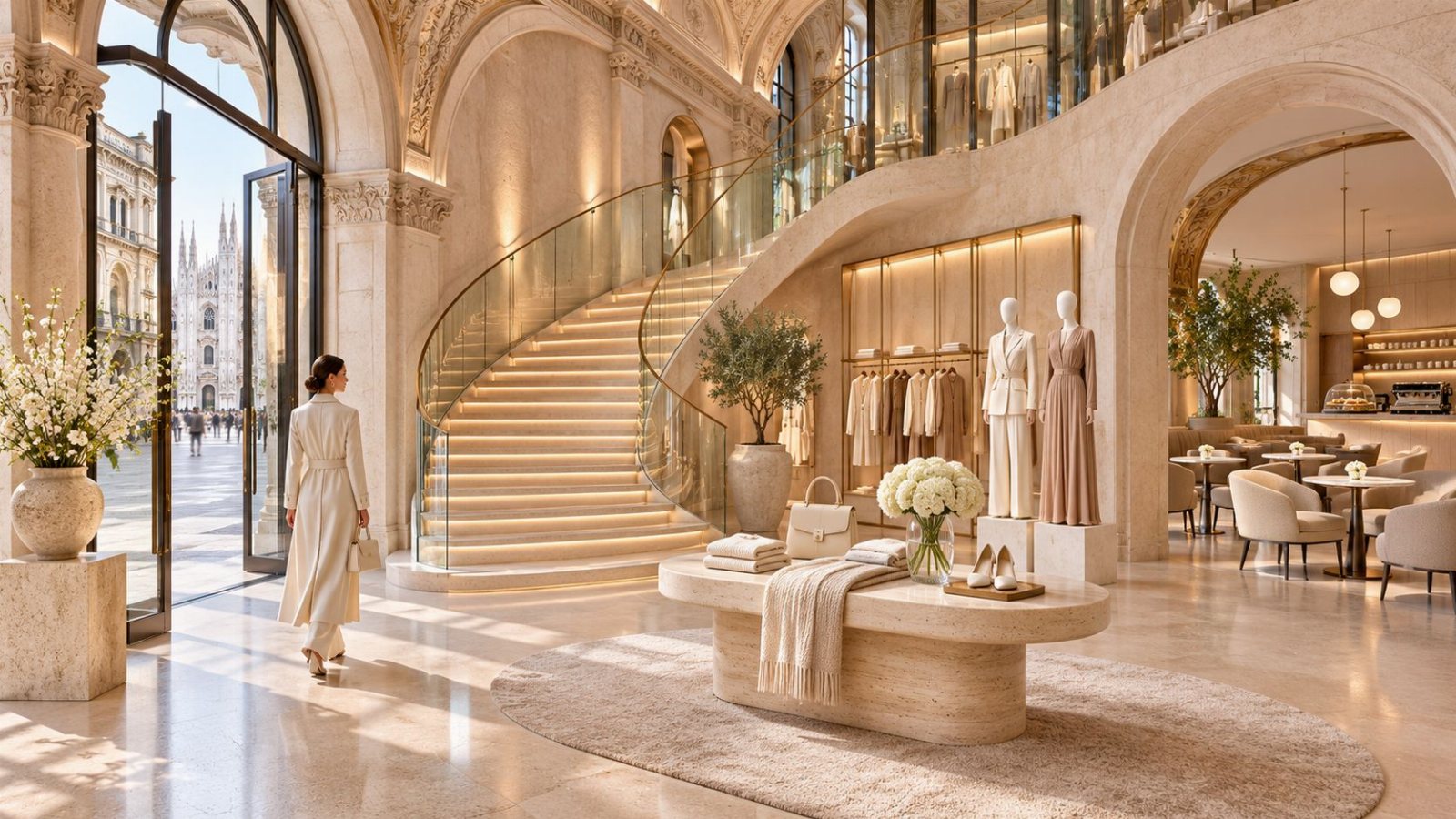
Picture a visitor walking into a historic palazzo in the Quadrilatero della Moda (Milan's fashion district) and finding not a sales counter, but a staircase, a display window and a bar. What are they buying at that moment? A Milan flagship store is a statement of identity built from stone, light, routes and people. The Montenapoleone district recorded around 11 million visitors in a year and an indicative average spend of around €2,500, according to Fashionbi's guide to Milan's luxury shopping destinations, in an area that concentrates around 300 top-tier brands.
Seven stores, three lenses for each: the architecture that tells the brand's story, the storytelling that keeps it consistent, the customer experience from the first step through the door. This is not a shopping guide. It is a way of observing.
Contents
- 1. Louis Vuitton, Milan flagship store, Montenapoleone
- 2. Tiffany & Co. Milano, Monte Napoleone
- 3. Hermès Milano
- 4. Ferrari Flagship Store Milano
- 5. Prada Milano Galleria
- 6. Gucci Milano Monte Napoleone
- 7. 10 Corso Como Concept Store
- What each Milan flagship shows, side by side
- What a small store can take from a flagship
1. Louis Vuitton, Milan flagship store, Montenapoleone
A historic palazzo in the Quadrilatero houses the Louis Vuitton flagship designed by Peter Marino: women's and men's collections, footwear, home, the Da Vittorio Café Louis Vuitton and the DaV by Da Vittorio restaurant (Louis Vuitton Montenapoleone). The first thing you notice is not the bag in the window. It is the time the building gives to whoever walks in: they can sit down, eat, look at a display and come back the next day.
Here is how the three lenses read. The architecture tells the brand's story by using a period building as a container, with food and home alongside the collections. The storytelling is not on a sign: it lies in the fact that the restaurant carries the name of a recognisable cuisine and the brand travels in the background. The customer experience begins before the sale, with a reason to stay that costs nothing.
The store as a platform
In 2022 Primark opened its first Italian flagship at Via Torino 45, with around 5,000 square metres of sales space over five floors, and in the same building it located its Italian headquarters and a showroom for the fashion press (Savills research on retail in Italy). Commercial, corporate and media functions under one roof.
A flagship is not measured in square metres. It is measured by how many different functions it can hold together without mixing them up.
The trade-off is real: every function you add takes space away from direct sales. The café doesn't turn over as much as a wall of bags. But it keeps the customer inside the store and gives them a reason to come back without buying.
What to take away: a small store doesn't need a restaurant. It needs to decide which secondary function to add and what to remove to make room for it. Personalisation, order collection, a space where the customer can wait without feeling out of place. Anyone working on these topics inside a chain will find a first framework in the retail marketing section.
2. Tiffany & Co. Milano, Monte Napoleone
Opened in 2025, the Milan flagship is described by the brand as its largest European location: a large display area, historic architecture and arched windows in Venini glass inspired by an original design by Gio Ponti (Tiffany & Co., Milano Monte Napoleone store). Here the shop window is a permanent element, not a billboard.
Two ways of using the shop window
The useful comparison is with those who change their window. The Baldinini flagship in Milan works on the concept "Il Fil Rouge" (the common thread) with three drivers, freedom, comfort and detail, and uses LED walls segmented on three levels to create a digital stage set (Il Prisma, Baldinini flagship). The window becomes an updatable device, synchronised with campaigns and launches.
The weak point lies in the missing numbers: the source publishes no before/after data on footfall, conversion or sales. A serious test compares like-for-like periods with and without dynamic content, measuring entries, the rate at which people stop in front of the window and sales attributable to the campaign, separating the effect from seasonality and promotions.
A window that changes every week requires a production process. Without that process you're back to the billboard.
On the services side, Tiffany offers engagement ring consultations, engraving and jewellery care, by appointment. This is the point where the store meets the online channel, between appointment, configuration and delivery; anyone designing that step will find references in the e-commerce section.
3. Hermès Milano
A neoclassical palazzo in the Quadrilatero, several floors, French and Milanese references blended together: Venetian terrazzo floors, geometric glass, areas dedicated to beauty, fragrance, home and made-to-measure creations with Hermès Horizons. The visit serves to observe one thing only: how the brand's sixteen métiers live side by side without the story falling apart (Hermès, Milan opening).
Consistency shows in the details
Materials: the Venetian terrazzo reappears in different departments and holds together spaces that would otherwise feel like separate shops.
Route: the staircase imposes a passage, and therefore a rhythm. Whoever goes up has already seen something.
Service: the made-to-measure area changes the tone of the conversation, not the logo hanging on the wall.
The trade-off is practical: the offer is wide and takes time, and the published opening hours show it is closed on Sundays, so a professional visit has to be planned on a weekday. For a multi-brand store the lesson is not to sell more. It is to decide which detail stays identical in every department, even when the product changes completely.
If the customer recognises the store without reading the sign, the consistency works. If they need the sign, it doesn't.
4. Ferrari Flagship Store Milano
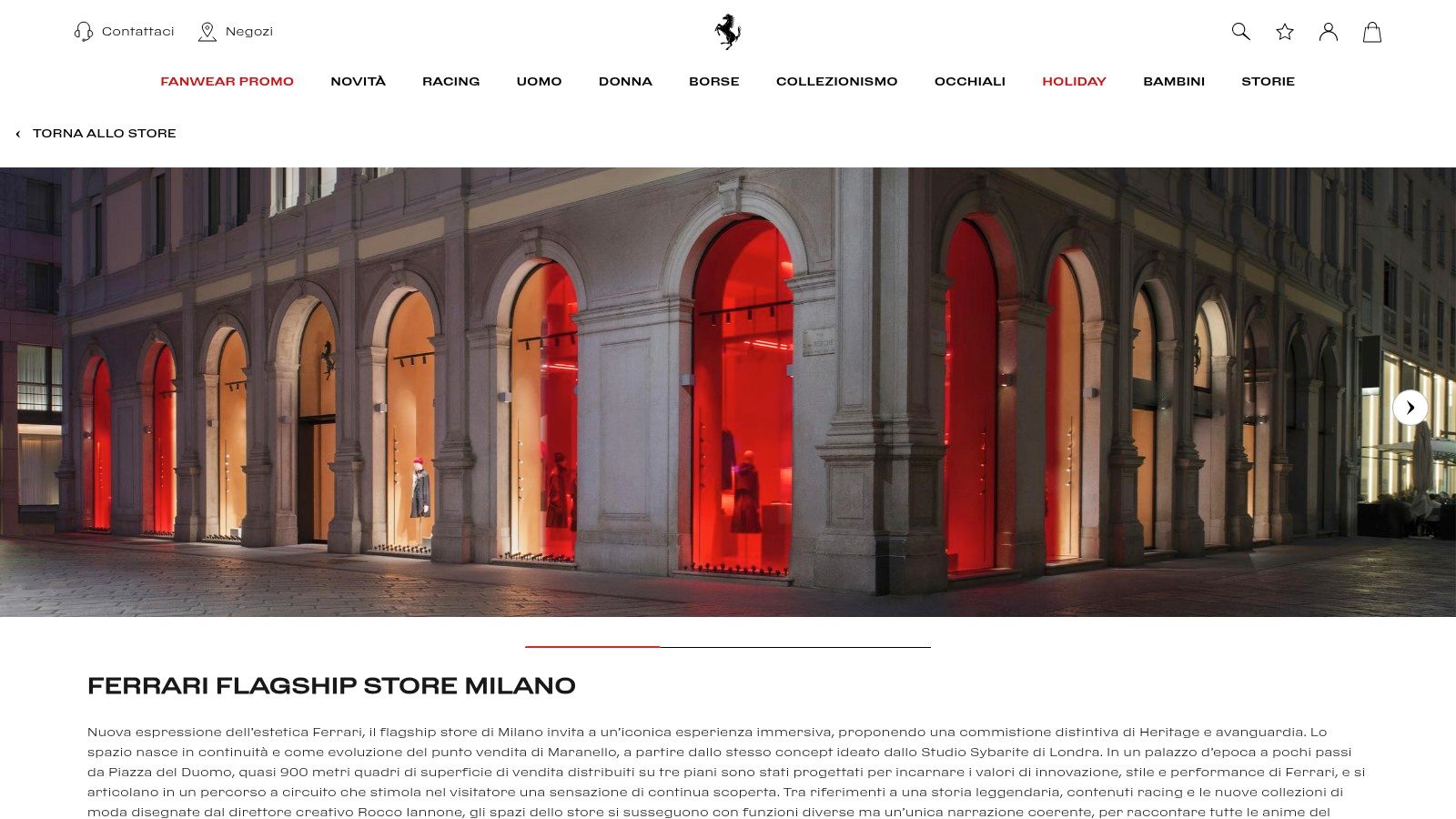
A few steps from the Duomo, almost 900 square metres over three floors with a route inspired by a racing circuit: fashion, accessories, racing content and installations, including a replica of the single-seater in which Michael Schumacher won the 2002 championship (Ferrari, Milan store). Services by appointment and personalised initials on a selection of leather goods.
A single focal object
The single-seater does the job that in many stores no element does: it provides a point of reference. Whoever walks in knows where to look, and the route starts from there. The risk is the mirror image: a display this specific works for this brand and for no other, and it can't be transferred.
What you copy: not the car, but the rule. One object, one wall, one product detail at the centre of the scene, and everything else revolving around it. In a small store it means giving up filling every linear metre.
What you don't copy: extensive personalisation with initials, which requires logistics and time. Before promising it, check who does it and how long it takes.
What you measure: how many people stop in front of the focal element and how many then ask for information about a product. Two observations a week are enough to tell whether the element is working.
5. Prada Milano Galleria
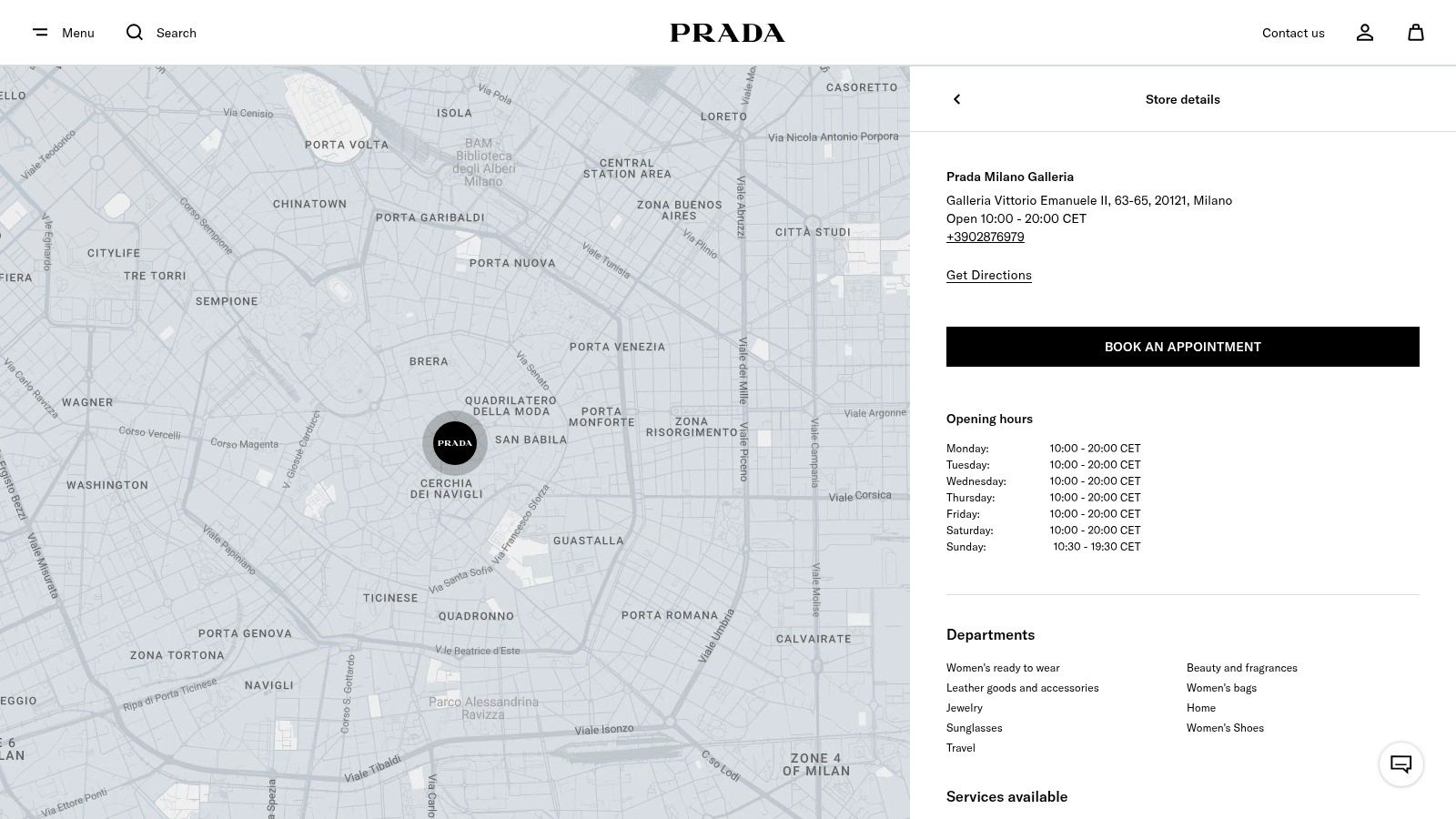
The boutique is in the Galleria Vittorio Emanuele II, and the official listing includes clothing, leather goods, bags, footwear, jewellery, home and travel, with private appointments and a made-to-order service (Prada, Milano Galleria women's boutique). The listing covers the women's boutique: Prada's other locations in the city may organise spaces and services differently, and this needs checking before drawing conclusions.
The setting is part of the experience
In the Galleria the visitor compares without moving. Different brands share the same building, and judgement comes from the immediate comparison. The density makes a list of addresses without criteria of little use: in the Quadrilatero della Moda Savills counts over 480 stores, with 33% represented by international brands and 71% by chains (Savills, analysis of the Quadrilatero della Moda).
The question is not where to go. It is what to look at, and in what order.
Three observations to make on a visit: how the queue is managed, whether the private appointment changes the route through the store, how much space is given to categories that are not the core, such as home, travel and jewellery. They are the same three points a chain owner can check in their own stores without any equipment.
6. Gucci Milano Monte Napoleone
A wide assortment: women's and men's collections, footwear, bags, jewellery, watches, décor and beauty. The store listing includes in-boutique appointments, remote sales, in-store collection, returns and exchanges (Gucci, via Monte Napoleone 5/7). This is the case where the customer experience lens meets the data lens: the store is not only a point of sale, it is a hub between channels.
The data the store can already use
In the SHOP 2.0 project for the MAX&Co. flagship in Milan, Carlo Ratti Associati placed sensors across the sales floor to capture data on products and their position, which can be shared with customer profiles and used by recommendation algorithms for cross-selling (Carlo Ratti Associati, MAX&Co. project). The interesting step is not the sensor. It is the link between product, position and profile during the physical visit.
The source publishes no outcome KPIs, so the project counts as an implementation case, not as proof of performance. Anyone wanting to measure it should look at:
Rate of interaction with the sensors, that is, how many visits generate usable data.
Share of recommendations accepted, to tell whether the suggestion arrives at the right moment.
Change in average transaction value and impact on service times, measured over comparable periods.
GDPR compliance for profiling and processing behavioural data, before linking a customer profile to a route through the store.
7. 10 Corso Como Concept Store
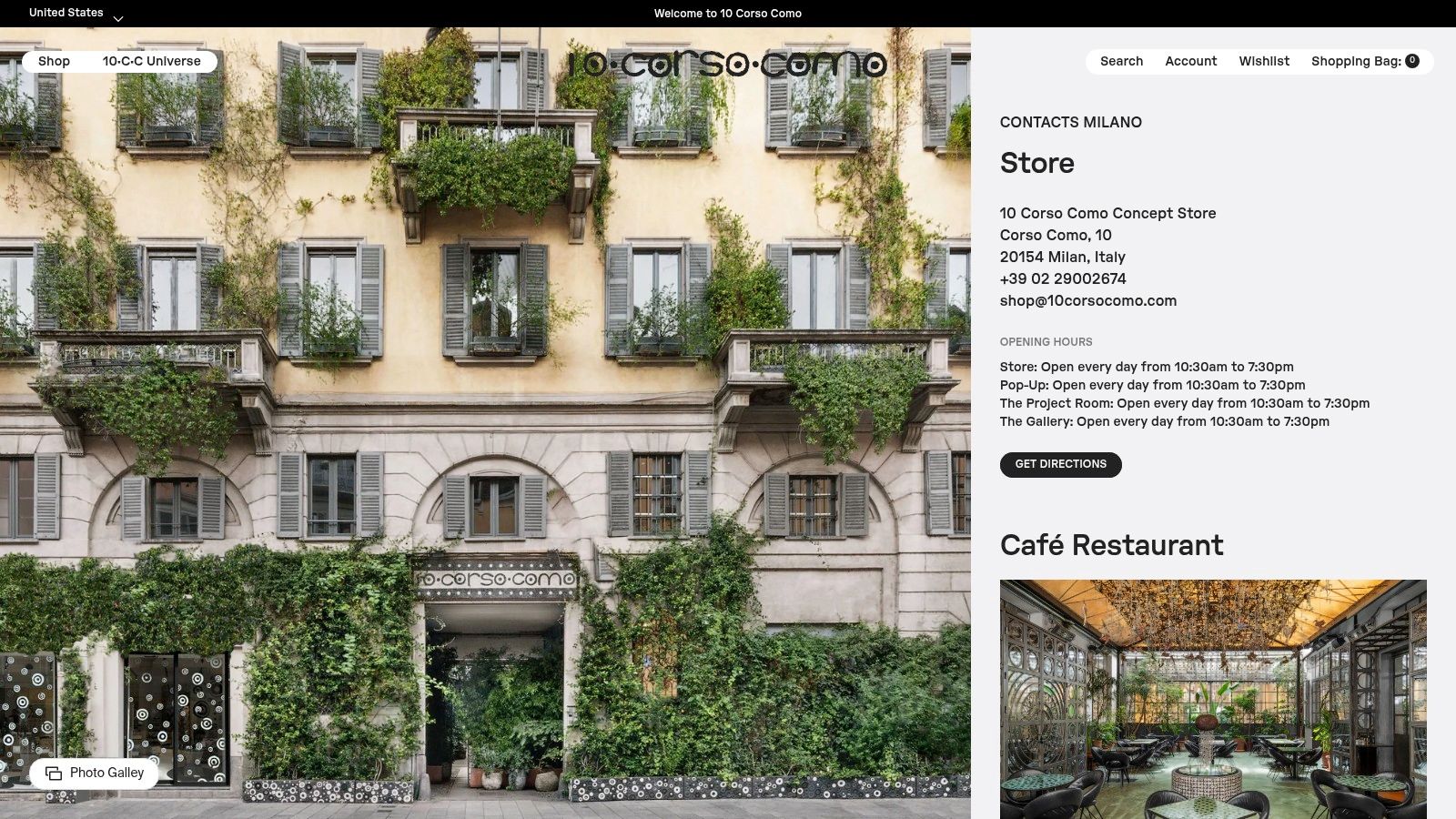
Here the model is different: a multi-brand selection, pop-ups, Project Room, gallery and café in the same courtyard. The store, pop-up, Project Room and gallery are listed as open every day from 10:30 to 19:30, while the café keeps longer hours (10 Corso Como, Milan store). The reason you stay is not a department. It is the sum of things to do.
Seasonality changes the visit
Milan recorded around 9.66 million visitors in 2025, with estimated growth of 6.5% on the previous year, and for 2026 a forecast of around 10.7 million arrivals has been given, linked partly to the Olympic event (RoadGenius, Milan tourism statistics). Design Week 2025 concentrated over 1,600 exhibitions, installations, presentations and events.
This means the same visit has to be made at least three times: a weekday, a tourist weekend and an event week. Waiting times change, as do product availability, the languages spoken at the counter, how bookings are handled and the continuity between social media, website and store. A traffic peak doesn't improve the experience. It often lines up the problems, precisely in the most visible stores.
The contrast with the single-brand store
A concept store doesn't teach you how to build a brand. It teaches you how to build a reason to stay. Anyone working on the in-store experience will find a framework in the experiential marketing section.
What each Milan flagship shows, side by side
| Store | Setting | Stated size | Services by appointment | What to observe |
|---|---|---|---|---|
| Louis Vuitton Milano Montenapoleone | Palazzo Taverna in the Quadrilatero, with spaces designed by Peter Marino, art and dining | Historic palazzo with spaces designed by Peter Marino | Appointments and personalisation services | Integration of sales, design and hospitality |
| Tiffany & Co. Milano, Monte Napoleone | Historic architecture, contemporary design and Venini glass windows | Venini glass windows and contemporary design | Appointments, engagement ring consultations, engraving and jewellery care | Use of Italian design and personalised consultation |
| Hermès Milano | Neoclassical palazzo over several floors, with Milanese references and Venetian terrazzo details | Several floors with Venetian terrazzo details | Hermès Horizons made-to-measure service | Brand consistency across different categories |
| Ferrari Flagship Store Milano | Route inspired by racing circuits, with fashion, accessories and motorsport content | Almost 900 m² over three floors | Private appointments and personalised initials on selected items | The car installation and the shift from motorsport to lifestyle |
| Prada Milano Galleria | Boutique in the historic Galleria Vittorio Emanuele II | Boutique in the Galleria Vittorio Emanuele II | Private appointments and made-to-measure service | Dialogue between historic setting and contemporary luxury |
| Gucci Milano Monte Napoleone Flagship | Boutique in the Quadrilatero with a wide assortment for men and women | Wide assortment for men and women | Appointments with dedicated consultation | Range of merchandise and services in store and remotely |
| 10 Corso Como Concept Store | Multi-brand space with gallery, Project Room, pop-ups and café | Gallery, Project Room, pop-ups and café | Multi-brand approach with exhibition spaces and hospitality | Meeting point of commercial selection, culture and hospitality |
A useful comparison doesn't just line up the most photographed windows. It reads each flagship through three lenses. The first looks at the architecture that tells the brand's story. The second observes the storytelling carried by the space and the staff. The third follows the customer experience from the first step through the door.
The practical point comes at the end of each reading: an action that can be replicated in a small store. You don't need to reproduce a palazzo. You need to understand which detail can become visible even with fewer square metres, fewer staff and a shorter assortment.
Louis Vuitton and Tiffany show two different ways of using history. The first works with Palazzo Taverna, with Peter Marino, art and dining. The second holds together historic architecture, contemporary design and Venini glass windows. In both cases the value comes from the sequence. The customer enters a recognisable place, encounters consistent materials and receives a service that carries the story forward.
Hermès and Ferrari are sharper in how they build their language. Hermès keeps consistency across different categories in a neoclassical palazzo over several floors, with Milanese references and Venetian terrazzo. Ferrari translates motorsport into a route, fashion, accessories and content, with almost 900 m² over three floors and a car installation as a point of orientation. The risk here is mistaking the set for the method. The set works when it sharpens the product's positioning.
Prada and Gucci play on the density of their surroundings. Prada is in dialogue with the Galleria Vittorio Emanuele II. Gucci works in the Quadrilatero with a wide assortment for men and women and dedicated consultation. For a small store the lesson is not to widen the offer. It is to choose more rigorously what to put on display and what to explain at the counter.
10 Corso Como closes the comparison with a different structure. Gallery, Project Room, pop-ups and café create reasons to linger alongside the commercial selection. Its lesson is about time more than luxury. A small store can replicate the principle with an area that changes, an object explained well and a moment of hospitality that can be measured.
So the grid should be read like this: architecture, storytelling, customer experience. Each row shows what to observe and where replicability comes from. An architectural detail should be copied only if it speaks of the brand. A story should be kept only if the staff can repeat it simply. A service should be introduced only if the store can sustain it on peak days.
What a small store can take from a flagship
The first step is not copying a palazzo. Choose three elements your store can make visible: an architectural detail consistent with the brand, a story the staff can tell in two sentences, a moment of welcome you can observe for a week before changing it. Then check whether it holds up on a Saturday afternoon too, with a queue at the till and the stockroom calling.
There is also the question of tools. If an AI system arrives in the store, even just to read reviews or suggest products, since 2 February 2025 Article 4 of the EU regulation on artificial intelligence has required those who use it professionally to ensure a sufficient level of AI literacy among their staff, proportionate to the context and the risks (EUR-Lex, EU regulation on artificial intelligence). It is not the same course for everyone: it means documenting who uses what, for which activity and with what limits. Full application of the regulation is scheduled from 2 August 2026.
To observe these elements in person, Milano Retail Tour runs guided visits in small groups to Milan stores, with a researcher and a final workshop on what was seen. After the Preview on 12 November, the next 2026 date is 11 December. The programme doesn't promise results: it helps you understand what to observe before changing anything.
If you want to work out which detail to start from in your store, book a meeting.
Before redoing a display or moving the counter, it's worth pausing on three questions. They are the same ones that separate a flagship from a store trying to look like one.
Does whoever walks in know where to look? If the answer has to be explained out loud, the focal element isn't working. In a small store it means a single point of attention per wall, and everything else revolving around it.
Can the staff describe the store in two sentences? If everyone tells a different story, the customer gets three different brands in the same space. Two sentences written down and shared are worth more than a day of training.
What happens in the fifteen seconds after entering? The look, the first sentence, where hands go. Two observations a week are enough to tell whether that moment is designed or left to chance.
The answers don't come in a meeting. They come from being in the store, during opening hours, with a notebook and without stepping in while the customer is at the counter.
You don't copy a flagship. You choose one detail, try it for two weeks and see whether it has shifted anything, or you remove it.
What remains is the habit that makes the visit useful: taking notes with the same template. Three columns on a sheet: what you see, why it works, what you can try on Monday in your own store. The third column is the one that usually stays empty, and it is the only one that produces change.
What you see: the physical detail, the light, the position of the counter, the time the staff let pass before approaching.
Why it works: the function that detail performs, not the aesthetic judgement. A staircase that slows your pace has one function, an armchair that keeps a waiting customer has another.
What you replicate: a small change, with a person responsible and a date. If the entry stays generic, it isn't a move, it's an intention.
A template filled in at three different stores tells you more than ten photographs. It also tells you what isn't worth copying, which is the part nobody writes down.
Sources: Fashionbi, A guide to Milan's luxury shopping destinations; Savills Italia, retail research 2024; Carlo Ratti Associati, SHOP 2.0 project for MAX&Co.; Il Prisma, Baldinini flagship; Savills, analysis of the Quadrilatero della Moda; RoadGenius, Milan tourism statistics 2025; EUR-Lex, EU regulation on artificial intelligence.