

 Italiano
 English
Published ·

The quote went out on Tuesday, after a one-hour site visit. On Thursday the salesperson made the first follow-up call, on Monday the second. No answer from the other side, and nobody in the company can say whether the sticking point is the price, the delivery or the question that wasn't asked that day.
The scene repeats itself in every store network. A negotiation is decided in two or three moments that nobody writes down, and sales techniques training stays a classroom with slides, far from the counter where things actually happen.
This list puts forward eight exercises. Each one involves a language model, that is, a program trained to read and write text, running on a company computer or server. An agent, along the same lines, is a model that has been given a role and some tools, for example consulting product sheets or data from the management system. On-premise means only this: the program and the documents sit on a machine you control, not on someone else's service.
For each exercise you'll find what it trains, how it is measured in the field and which part of the work stays in-house. Customer records, price lists, confidential terms and conversations with customers have no reason to leave the company network to produce a sales exercise.
The model is the same for everyone. Your documents are not.
Contents
- 1. Simulating negotiations with a local AI agent
- 2. Local analysis of sales calls for coaching
- 3. A RAG product assistant for sales staff
- 4. An objection-handling library built from internal notes
- 5. Local review of quotes and sales emails
- 6. Personalised training paths built from internal procedures
- 7. Natural-language analysis of sales data for the store manager
- 8. In-store customer service practice with local support
- The eight techniques compared
- Three moves for the week, one single question
1. Simulating negotiations with a local AI agent

A salesperson who wants to practise handling the price objection has a practical problem: real customers are few and can't be used up. The agent plays the customer, asks for a discount, drags a competitor into it, and the salesperson replies by chat or by voice. The feedback comes straight away, while the memory of the negotiation is still fresh.
The difference from a course lies in the material. If the model runs on a company server, the agent can work with the real commercial terms: the maximum discount per product family, delivery times, the exceptions the area manager knows by heart. None of those numbers passes through an outside provider.
There is also a market reason why training in-house pays: according to the EURES report based on the Excelsior analysis, in 2023 the share of hard-to-fill jobs for Italian businesses reached 46%, compared with 40% in 2022 and 26% before the pandemic (Cedefop, Skills anticipation Italy 2023). If you can't find salespeople who are ready, you have to build them.
Picture a chain of six furniture stores: before the weekly meeting, the store manager runs the scenario "customer asking for a discount after the site visit" for ten minutes, then talks it through with the salesperson.
Three conditions for not wasting it
Start from real objections. Five or six, picked out by the sales manager from the latest meetings. A generic list produces a generic exercise.
Have the scenarios validated. An experienced salesperson reviews texts and constraints before the team uses them: if the agent concedes things the company doesn't concede, the exercise teaches the wrong thing.
Measure in the store. The exercise score tells you who completed the session, not who changed the way they sell.
For how a model that stays inside the company works technically, it's worth reading about how a local LLM works.
2. Local analysis of sales calls for coaching
Picture a distributor of window and door materials that notices offers stalling at the second contact. The system transcribes the calls and flags three things: how many open questions the salesperson asked, how much they talked compared with the customer, which objections were left unanswered. The manager receives a summary for each person and uses it in the coaching session.
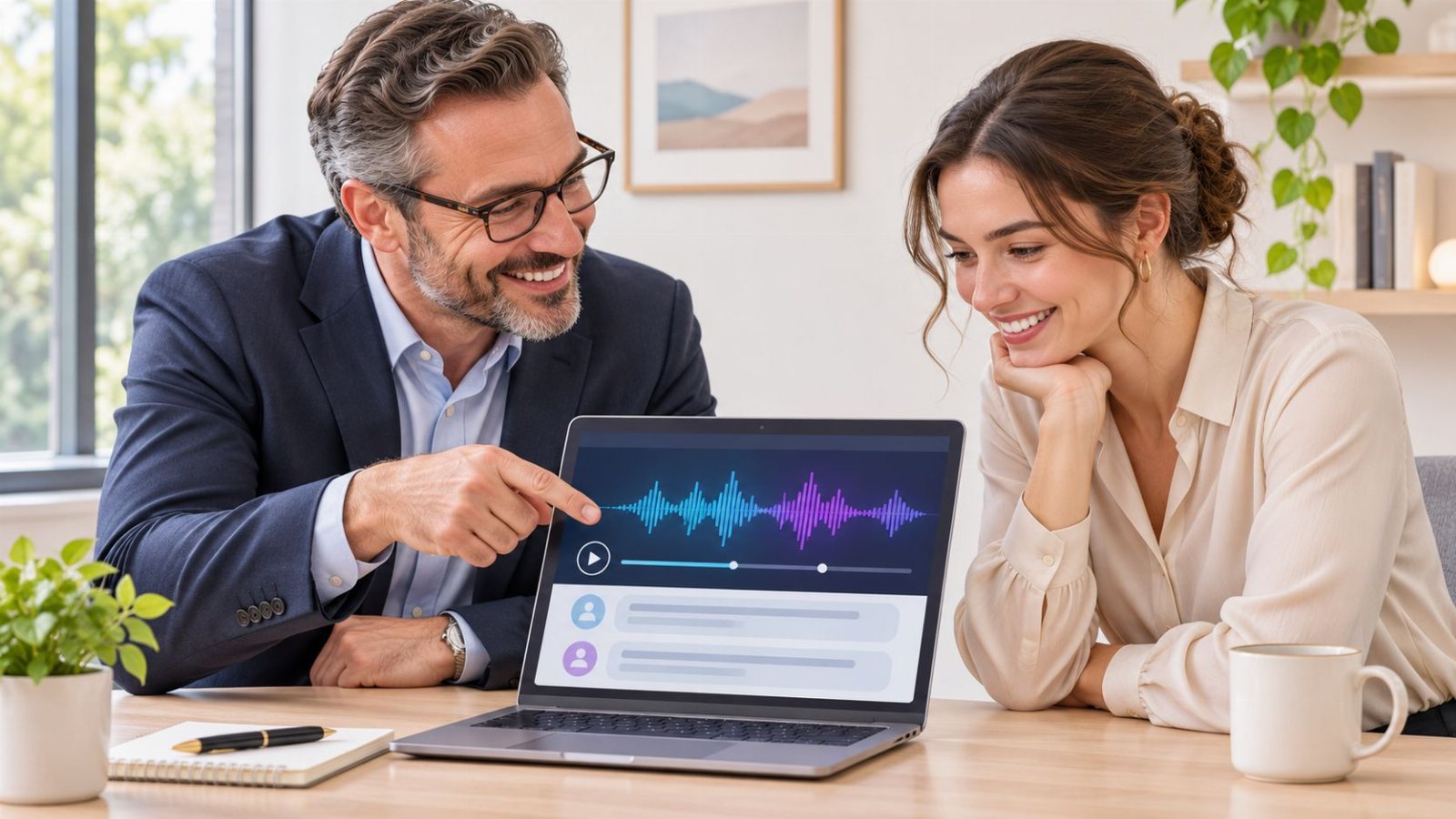
The transcription runs on a company computer or server. The content of the conversations does not pass to outside providers, and that is the condition that makes the project acceptable to a sales team.
An Italian survey on how the sales function is evolving, reported in Gestire la sales transformation (Managing sales transformation), involved 1,028 managers from sales, marketing, HR and general management, and dealt separately with skills, sales force training and the role of the customer. The separation is the point: technique, process and result are three different things and must be measured separately.
Rule of thumb: the indicators are shared with the team before the system is switched on, not after the first analysis. A system that arrives without explanation is perceived as surveillance.
On the data side, recording calls requires a legal basis, a privacy notice and defined retention periods. The conditions are set by the Garante per la protezione dei dati personali (the Italian Data Protection Authority), and they must be checked before the project starts. Keeping audio and transcripts inside the company network simplifies the scope; it does not remove the obligations.
3. A RAG product assistant for sales staff
RAG, retrieval-augmented generation, means the model doesn't answer from memory: it first searches the documents chosen by the company, then builds the answer on those and points to the passage it took it from. Technical sheets, price lists, warranty terms, returns procedures.
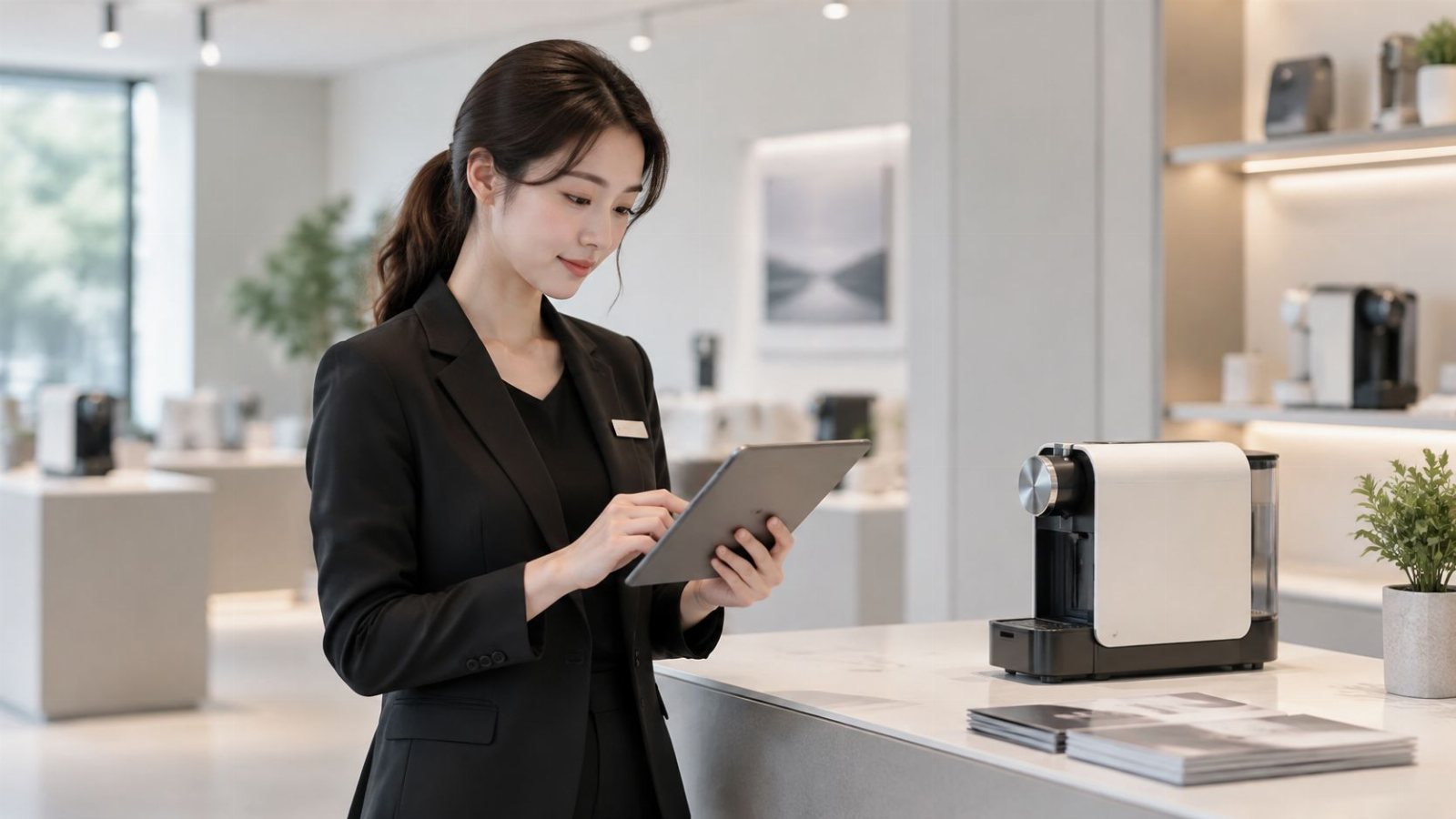
The salesperson asks in natural language how one product compares with another, or which warranties cover a product line, and gets an answer that can be checked. What is being trained is not memory: it is the ability to ask the right question and to check the source before repeating the sentence to the customer.
The Excelsior system run by Unioncamere and the Ministry of Labour lists among the skills to watch the ability to describe and promote products and services, to communicate in Italian and in foreign languages, and to organise and assess qualitative and quantitative information (Excelsior sheet, Cedefop). A well-built assistant makes those skills something you can practise every day, not only in the classroom.
What it takes to hold up
Start from 20 or 30 up-to-date product documents, not the entire archive. Decide who approves a document before it goes into the system: without someone responsible for the content, the assistant learns old versions. And ask the team to report wrong answers, because they are the most honest test of the project.
A typical case: a workshop that sells spare parts and repair kits checks compatibility between two models before preparing the quote, without leafing through three catalogues.
4. An objection-handling library built from internal notes
Recurring objections are already written down somewhere: in CRM notes, in worksheets, in reply emails. The problem is that nobody has ever put them in order. A local model reads that material, groups it by type, summarises it and suggests an answer to adapt to the individual case.
The system does not replace the salesperson's judgement. It makes available the knowledge the team has already produced, including that of senior salespeople who have never written a handout.
The order of work matters. According to the Emarsys AI in Retail Report 2025, at the start of 2025 35% of Italian retailers believed AI had already had a significant impact on their business model, while a further 48% expected that impact by the end of the year. With tools entering the store at this speed, your team's sales competence is the variable that stays under your control.
Three steps, in this order:
Count the recurring objections. One month of existing notes is enough to see how many are really recurring and how many are isolated cases.
Have two or three experienced salespeople review it. The library is validated by the people who closed the deals, not by the people who write well.
Update it every quarter with closed cases. A library stuck at twelve months ago describes a market that no longer exists.
Example: a catering supplies company collects the answers on the theme "the competitor is cheaper" and uses them to train new agents, on condition that the sentence is always adapted to the customer in front of them.
5. Local review of quotes and sales emails

In many companies, a quote above a certain threshold goes out without anyone having reread the payment terms. The model reads the draft and flags what is missing: terms, delivery times, the benefits tied to the proposal, an explicit closing question. The salesperson remains the author of the message and decides what to keep.
Here, where the model sits matters more than anywhere else, because the text contains prices, discounts and confidential terms. A model running inside the company works on that data without sending it out.
The context this exercise fits into is not neutral. According to Istat, in 2024 Italian retail trade recorded an annual increase of 0.7% in value, while sales volumes fell by 0.4% (Istat, Retail trade December 2024). When volumes fall, a mistake in the terms costs more than in a growth phase: you sell the same, you earn less.
A checklist of 8 or 10 points, approved by sales management, is worth more than a big model. The model carries out the list; it doesn't invent it.
Use the review as a training moment: going through the suggestions together once a week teaches the salesperson to make on their own the checks they used to skip. And keep the approved versions as internal reference templates.
6. Personalised training paths built from internal procedures
The mandatory AI training required by the AI Act is not a sales programme. The two sit side by side; one does not replace the other, and it's worth keeping them distinct in internal communication too.
The real material for a sales programme is already in the company: welcome procedures, product manual, discount policy, returns handling. A local model builds for each person a sequence of readings, check questions and practical cases, calibrated to their role and starting level.
The reason to build it internally lies in participation: according to the OECD, in 2024 only around 11% of adult workers in Italy took part in education or training, roughly half the combined average of the European Union and OECD countries. The generational gap is small but real: 34% of employed people aged 25 to 44 took part in non-formal training in the last twelve months, against 32% of those aged 45 to 64.
This means one practical thing: a programme must be designed for the company's entire workforce, combining the experience of senior salespeople with the digital upskilling of younger profiles.
Start from a single critical procedure. Returns handling, for example, and measure its effect before extending the programme.
Make one internal person responsible for the content. If the programme is written only by the supplier, it goes out of date in a month.
Build in observation on the shop floor. The online check tells you whether the procedure has been read, not whether it has been applied.
Picture a chain of four clothing stores preparing a three-week programme for new hires, based on its own welcome procedures, with a check on the shop floor at the end of each week.
7. Natural-language analysis of sales data for the store manager
"Which products sold less last month compared with last year?" The store manager types the question in Italian and gets an answer built on the data from the management system, without exporting spreadsheets.
The training benefit is indirect and more interesting: the manager can guide the team in reading the numbers and linking a result to a behaviour. A dip in returns, for example, becomes a question to raise at the weekly briefing instead of a figure to comment on at the end of the quarter.
The gap to close is documented. According to Istat, in 2024 8.2% of Italian businesses with at least 10 employees used at least one artificial intelligence technology, against 5.0% in 2023. Size matters: the share reached 32.5% in businesses with at least 250 employees and stayed at 6.9% below 50. In the EU27 the share was 13.5%.
For a network of 3-15 stores, the consequence is that the project must start from narrowly defined cases, not from a platform.
Check the first 20 answers against the management system. If they are wrong, the problem lies in the data or the definitions, not in the model.
Restrict access to margin data to the roles that need to see it. A convenient assistant is also an assistant that exposes.
Use the answers to frame coaching questions, not to judge a person in a meeting.
On how to set up the first step in an SME, the reference reading is artificial intelligence for SMEs.
8. In-store customer service practice with local support
A question comes up while the customer is standing at the shelf: how long after purchase an exchange is possible, whether the warranty covers that defect, whether delivery includes assembly. An assistant that can be consulted from a device in the store answers from internal documents. The sources must be welcome procedures, warranty periods, rules on returns and exchanges, kept up to date and recognisable to the salesperson.
The tool serves training and lookup during the shift. Customers' questions and information about returns stay inside the company: they are sensitive commercial data, and sending them out for a quick answer creates a risk greater than the benefit. Local support, on the other hand, makes it possible to link the answer to the internal procedure and to see straight away whether the text is clear to someone reading it on their feet, between two customers.
Differentiating by digital level is not an organisational detail. According to the Unioncamere Excelsior survey reported in the Excelsior glossary, 78% of Italians recognise that there is a digital skills gap, while among people with lower levels of education only one in four has access to training opportunities. If the system rewards only those who already know how to use it, training strengthens those who were already ahead.
Keep in mind: an answer in three seconds can discourage asking the experienced colleague. In-store practice must preserve that transfer of knowledge: after the answer, the salesperson asks the colleague why that rule exists and when it applies.
A realistic test starts from a single pilot store in a chain of five home furnishing stores. The assistant is used on the delivery and assembly rules during the opening shift, with direct observation of how customers are welcomed. Three things are looked at: whether the salesperson finds the answer without interrupting the customer, whether the explanation is consistent with the procedure, whether the customer understands the next step. Practical criterion: a slower but verifiable answer is better than a quick formula that leaves doubt. To set up the training oversight, the reference on retail marketing is useful.
The eight techniques compared
| Technique | What it improves | Where the model and data run | Initial effort | How it is measured in the store |
|---|---|---|---|---|
| Simulating negotiations with a local AI agent | Handling objections and negotiations | Model on a company server or computer; internal data | Setting up scenarios with real examples and validating them | Observing real negotiations and how objections are handled |
| Local analysis of sales calls for coaching | Quality of coaching and conversations | Transcription and analysis on a company computer or server | Defining indicators, privacy notice and privacy requirements | Comparing calls and discussing examples in coaching sessions |
| A RAG product assistant for sales staff | Accuracy and speed in answers about products | Model and documents on an internal server or computer | Sorting and approving the initial documents | Collecting wrong answers and checking the sources cited |
| An objection-handling library built from internal notes | Sharing the team's effective answers | Local model; notes and information stay in the company | Selecting and reviewing the available notes | Checking use of the suggestions and updating the library with closed cases |
| Local review of quotes and sales emails | Completeness and consistency of proposals | Local model; texts and commercial terms in the company | Defining a checklist and collecting approved examples | Comparing quotes with the checklist and reviewing the suggestions |
| Personalised training paths built from internal procedures | Consistency and personalisation of training | Local model and approved internal documents | Preparing content and checks controlled by an internal person | Observing how the procedure is applied on the shop floor and assessing results |
| Natural-language analysis of sales data for the store manager | Reading results and coaching activity | Local model connected to the management system or internal files | Cleaning and connecting the data; checking the first answers | Comparing answers with the management system and using them in briefings |
| In-store customer service practice with local support | Staff confidence and consistency of service | Assistant on an internal device; head office documents | Launching a pilot test and preparing the devices | Directly observing the quality of the welcome in store |
Three moves for the week, one single question
Before assessing any software, a store network can work on three concrete moves in seven days, without adding complexity. The point is not to buy a model, but to prepare the conditions for any tool to stay useful inside the company. You need internal materials, a store you can observe and a shared measure. Without these, even a well-configured assistant produces answers that are correct but hard to use.
Collect the five most frequent objections. Ask the sales manager to pick out from the latest meetings the sentences customers used to say no. They are the starting material for the eight exercises, in the classroom or with a model. Real sentences matter because a library of answers built on generic texts always sounds the same to different customers.
Choose a single technique and a single pilot store. Eight exercises launched together can't be measured. Just one, in one store, produces a readable comparison in a few weeks. The pilot also reduces the practical risk: you see straight away whether the salesperson uses the suggestion, whether the manager checks it and whether the procedure holds up in a real conversation.
Agree with the store manager how the effect will be measured. Observation on the shop floor of welcome, needs diagnosis, value argument and closing is worth more than an end-of-course satisfaction questionnaire. The measure must be on behaviour, because that is where a sales technique changes the result.
Before buying any tool, three operational questions remain. Which customer data goes into the system, and where it ends up. Who checks the outputs before they reach the customer: you need a responsible person, not a well-written policy. Who keeps documents and price lists up to date, because an assistant that reads old material produces old answers with great confidence. If commercial terms and conversations leave the company network, you lose control over what the system can say and who can review it.
For the observation side, one option is the Milano Retail Tour training module, which updates managers and teams on retail trends through guided visits to Milan stores, the ethnographer's notebook and a final workshop in which the observations gathered become ideas for your own brand, product or store. Technique is learned in the classroom. It shows in the store.
The tools that stay inside the company and the working method are described in local AI on your data; project examples are collected on the demo page and in the Ristopiù case.
Book a meeting to work out which of the eight exercises makes sense to launch first in your store network.
Sources: Cedefop, Skills anticipation Italy 2023 (EURES and Excelsior data); Gestire la sales transformation; Emarsys, AI in Retail Report 2025; Istat, Commercio al dettaglio (retail trade), December 2024; OECD, Economic Surveys: Italy 2026; Istat, Imprese e ICT (enterprises and ICT) 2024; Unioncamere, Sistema informativo Excelsior (Excelsior information system).