

 Italiano
 English
Published ·

The AI Act entered into force on 1 August 2024, but it doesn't all apply from that date: the first obligations kicked in on 2 February 2025 and the general framework becomes applicable on 2 August 2026. For a store there are several deadlines to note, and the most urgent one has already passed.
Meanwhile, adoption has moved faster than the rules. Companies have switched on artificial intelligence tools at a pace the regulation's calendar could not foresee, often inside software already in the store: tills, management systems, assistants for product pages. The result is that the obligations reach businesses where AI is already running, even if nobody ever recorded it under that name.
Entry into force and application remain two different things. The regulation has been law since 1 August 2024, the obligations arrive in stages, and the only way to understand which ones concern your own store is to start from an inventory of the tools already switched on.
Contents
- AI Act entry into force: the dates to note
- The first step is an inventory of the tools
- Staff training is already an obligation
- The store or the supplier
- Where the risk shows up at the till
- What to do before 2 December 2026
AI Act entry into force: the dates to note
1 August 2024 marks the start of the process, not the starting line for the obligations. The staggered timetable set by the text of Regulation (EU) 2024/1689 on EUR-Lex provides for a first application step on 2 February 2025, the general framework on 2 August 2026 and, for some provisions on high-risk systems, a final deadline of 2 August 2027.
| Date | What becomes applicable | What the store does |
|---|---|---|
| 1 August 2024 | Entry into force of Regulation (EU) 2024/1689 | No immediate operational obligation; the process begins |
| 2 February 2025 | Bans on unacceptable-risk practices and AI literacy (Article 4) | Start training the people who use AI |
| 2 August 2025 | Governance, penalties and general-purpose AI models | Check contracts and responsibilities with suppliers |
| 2 August 2026 | General application, transparency (Article 50) and part of the high-risk systems | Tell customers when they are interacting with an AI |
| 2 August 2027 | Provisions for some high-risk systems | Case-by-case check with the supplier |
Read the table by urgency, not chronologically. The two rows after the entry into force describe obligations already in place: a store that discovers them today is not ahead of the calendar, it is late on deadlines that have passed. The following rows are preparation windows, and the widest one closes on 2 August 2026.
Two clarifications change the planning. The regulation is binding in its entirety and directly applicable in the Member States, so no Italian transposition is needed for those dates to apply to a chain of three stores too. Alongside it there is Italian Law no. 132/2025, in force since 10 October 2025, which must be read together with the regulation, as set out in Safe Legal AI's overview of the Italian legal framework.
However, the amendments under discussion at EU level may move some deadlines: the dates above are the framework adopted today, and internal deadlines should be set on that basis.
Rule of thumb: three dates go in the diary, not one. 1 August 2024, 2 February 2025, 2 August 2026.
The first step is an inventory of the tools
The starting question is not what the law prescribes, it is what your store uses. Article 4 and the application timetable of Regulation (EU) 2024/1689 make training impossible to postpone: anyone using chatbots, recommendations or content generation must be able to document skills proportionate to the role, the context of use and the risks.
To take stock of the tools, sort them into three families.
- Tools you bought. An assistant for product pages, demand forecasting software, a review analysis service. They are tracked, they have a contract, someone signed them.
- AI built into software. The CRM's automatic segmentation, the e-commerce platform's product suggestions, the score the management system gives regular customers. The store uses it every day without calling it AI.
- Personal accounts. A member of staff who uses their own AI assistant account to answer reviews and pastes in names, order numbers, sometimes a whole complaint. Nobody decided it, so it doesn't appear on any list.
For each item, note four things: who uses it, with what data, to do what, who checks the result. Picture a neighbourhood perfumery with three stores that opens the list and finds seven active tools: four don't appear in any contract.
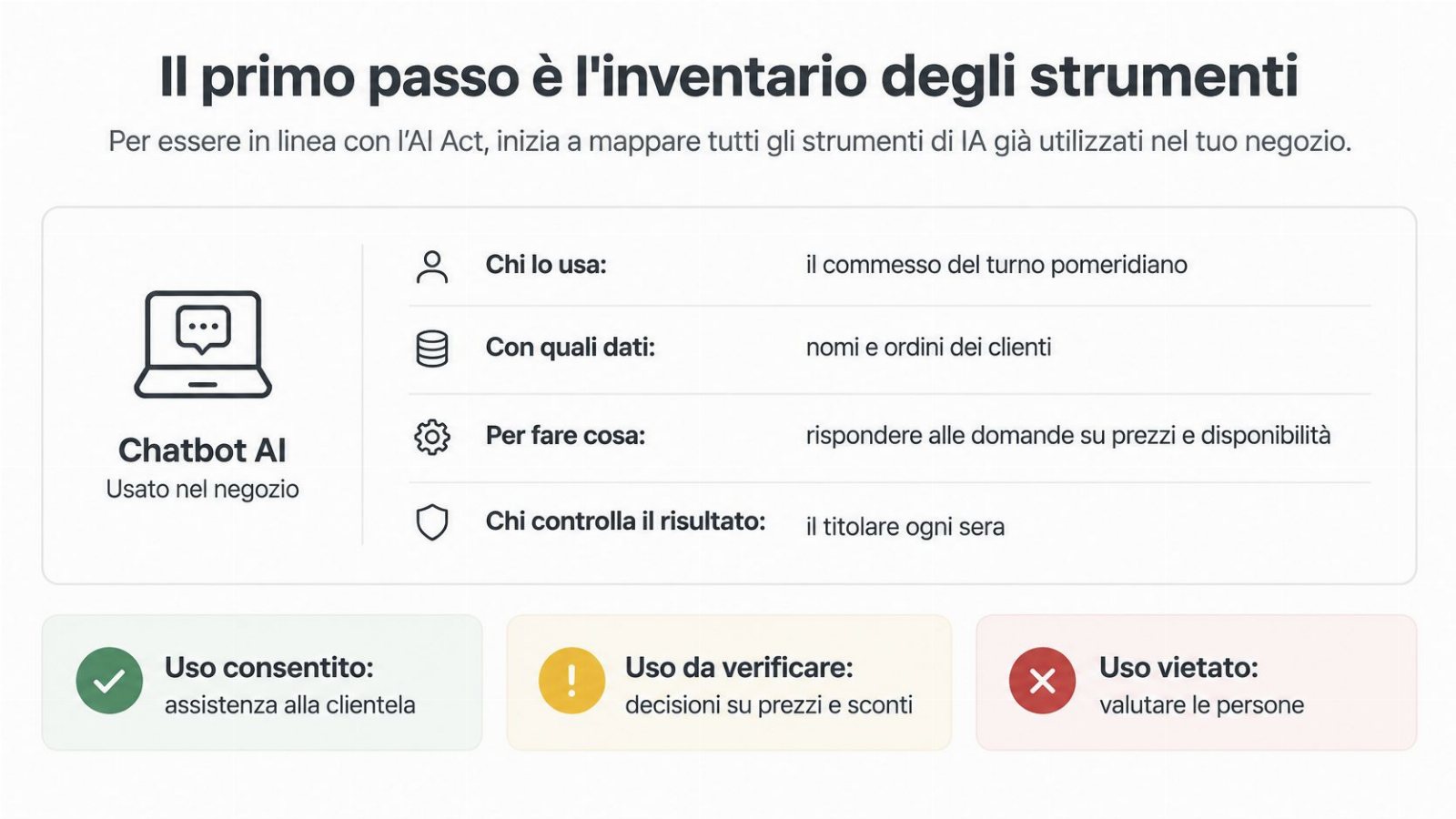
The same register serves twice: read once for the tool and once for the data. If you need an order of work, where to start with AI in the store comes before any impact assessment.
Staff training is already an obligation
Since 2 February 2025, Article 4 of Regulation (EU) 2024/1689 has turned AI literacy into a duty for providers and professional deployers: they must take measures so that those who use or operate the systems on their behalf have a sufficient level of skills.
The law sets no minimum share of employees and no standard number of hours. What counts is the relationship between technical knowledge, experience, education, training and the context in which the system operates: an assistant for product pages doesn't need the same oversight as a tool that affects priorities, answers or conditions offered to customers.
The scope is wider than IT. It covers marketing generating product pages, customer care answering customers, sales doing clienteling and management approving outcomes proposed by the system. Handing out a guide or signing the team up for a course is not enough: the ANCE analysis on AI literacy puts the ability to recognise opportunities, risks and possible harm at the centre.
Two checks are enough to see whether the training holds. The sales assistant who uses an assistant to describe a garment must be able to correct a wrong text before it reaches the customer. The manager who reads the review analysis must understand when the sample is too small to support a decision.
Document the essentials: who uses which tool, what instructions they received on results and data, what training they did and when. The augmented sales associate remains the operational reference to train; every change of tool reopens the procedure.
The store or the supplier
“The tool belongs to the supplier, so compliance is their problem.” It is the misunderstanding you hear most often, and it doesn't hold up.
Whoever uses AI remains responsible for how they use it and for the data they put into it. The Italian Senate's dossier on the AI Act points out that the status of provider or deployer has to be checked tool by tool: the same store can be a deployer for the chatbot and a provider for a system it resells.
Till, CRM and loyalty card data remain personal data subject to the GDPR even when they pass through an AI assistant. And the GDPR protects customers from decisions based solely on automated processing with significant effects: a discount refused on the basis of a profile can become a problem.
On penalties, precision matters. For violations of the prohibited practices the ceiling is 35 million euros or 7% of worldwide annual turnover, as summarised by QuotidianoPiù on the Italian implementation. That is the maximum for that category, not the typical amount for a chain of stores.
The second misunderstanding is treating the AI Act and the GDPR as two separate tasks. They are the same inventory read twice.
It pays to ask the supplier two things, in writing: where the data you enter ends up, and who can review the generated answers before they go out.
Where the risk shows up at the till
A customer asks the chatbot whether the model is available in blue. The chatbot gets the size wrong and promises a free return the store doesn't offer. At the till, that answer is the brand's word.

The second case is a price that changes automatically, or a discount refused on the basis of a profile, without the staff being able to say why. The third is profiling built on the loyalty card and purchase history. In all three the harm is not the penalty, it is the decision that nobody in the store can explain.
Two checks are needed. The first is transparency: customers must understand when they are interacting with an AI system, an obligation the AI Act applies from 2 August 2026 to generated or manipulated content too, as indicated by the European Commission's service desk. The second is human review: every automated answer or decision has a person who checks it before it goes out.
Take a neighbourhood optician with a WhatsApp assistant that proposes appointments. Two questions before switching it on: what is the sentence that discloses the AI, and who reviews the price proposals. The opposite case, AI that removes the trip to the till, is told in stores without tills: the Amazon Go case.
What to do before 2 December 2026
The first step is not a document, it is knowing what is running in the store.
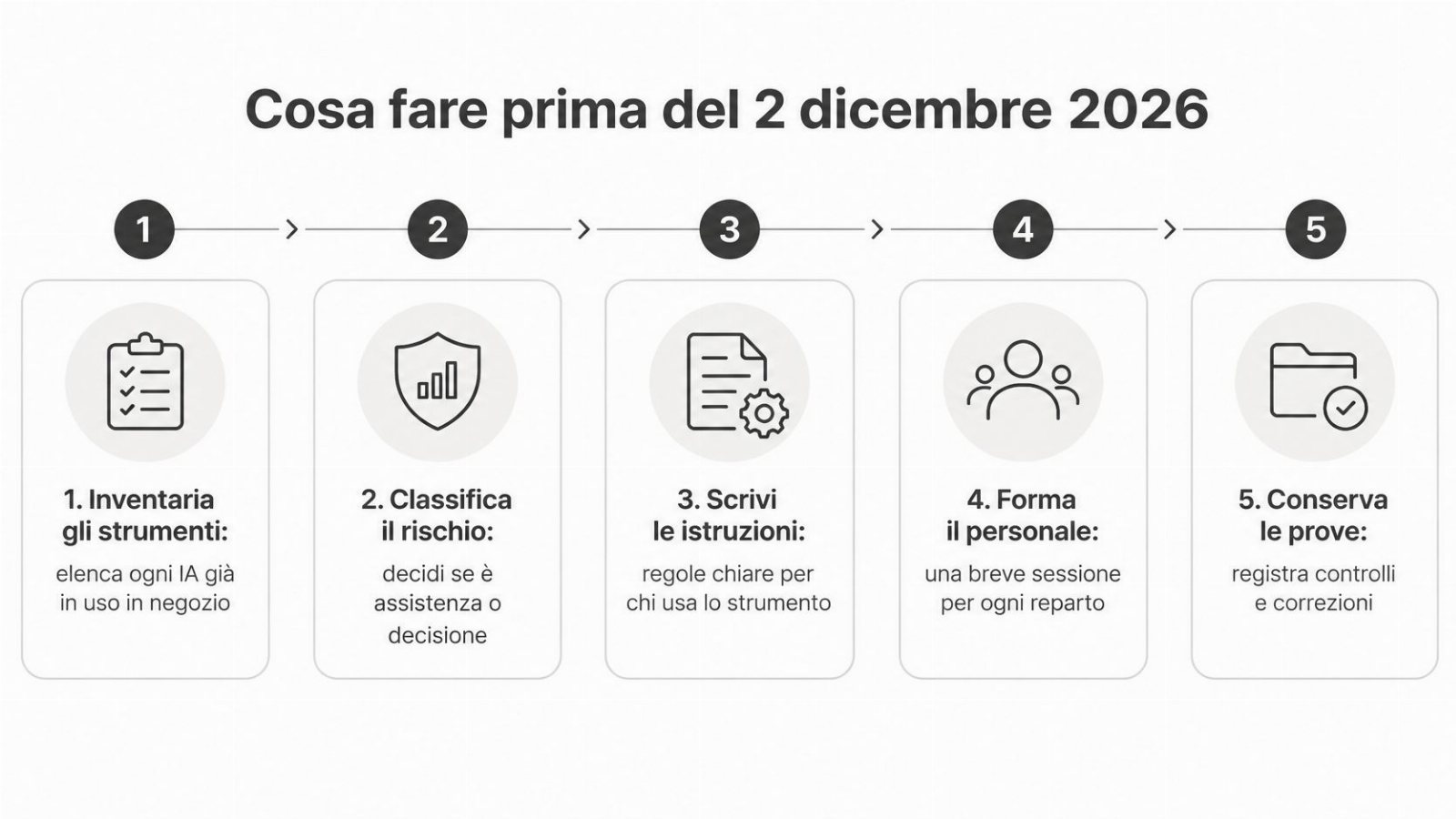
- Take inventory of the tools. List every use case, including those built into the management system, the CRM and e-commerce. Without a list you don't know whom to train or on what, and the first deadline stays uncovered.
- Assign an owner for each case. A name accountable for the result. Without one, the automated answer belongs to everyone and no one.
- Write a rule on data. Company accounts only, stating what must never be pasted into an assistant. If this is skipped, customer data ends up in tools you don't control.
- Train the staff and document it by role. Short, repeated, updated when the tool changes. Without a written record, the training can't be demonstrated.
- Check transparency and generated content. Disclose the use of AI where needed and check the labelling of content already in use. If you skip this step, the wrong promise reaches the till.
Even if the process stops at step one, you already hold what almost everyone lacks: a map of what the store really uses.
If you want to take that first step with someone who looks at the store and not only at the text of the law, Milano Retail Tour (MiRT) offers the MiRT Diagnosis: thirty minutes on a video call, free, to line up the tools you already use and understand which deadlines really concern you. You'll find the format and the other programmes on Milano Retail Tour. Request the MiRT Diagnosis and bring the list to the call, even if it's incomplete.