
 Italiano
 English
Published ·
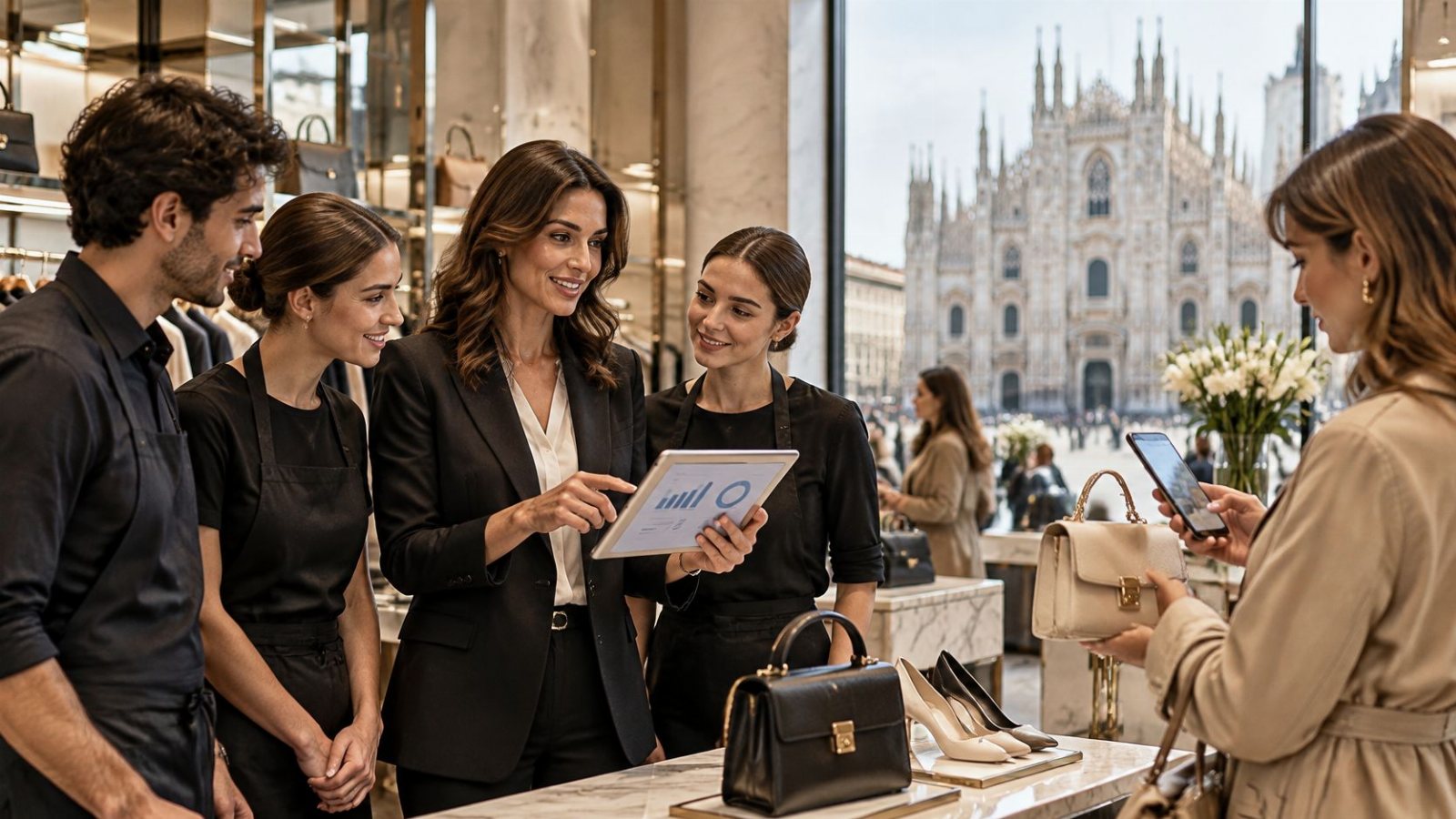
It's 9:30 on a Tuesday in November. Picture a neighbourhood store south of Porta Romana: shutter up, lights on, the shop floor to sort out before opening. The retail manager in Milan who arrives first has the rota, the stock deliveries and a question nobody asked five years ago: what has the first person who walks in already read on their phone?
That question decides how customers are welcomed, what is said first and which department to cover during the two peak hours. The rest of the job follows from there.
Contents
- The role of the retail manager in Milan today
- The skills that set a good retail manager apart
- Responsibilities towards head office, team and customers
- The Milan context and why it changes priorities
- Where to train in Milan and how to choose a programme
- What to do from next week
The role of the retail manager in Milan today
The retail manager runs a store or a small group of stores, up to a chain of fifteen, and is accountable for four things at once: financial results, people, range and customer welcome. The core of the job doesn't change between food, home and living, fashion, perfumery, optics, pharmacy and luxury. The weights change, not the substance.
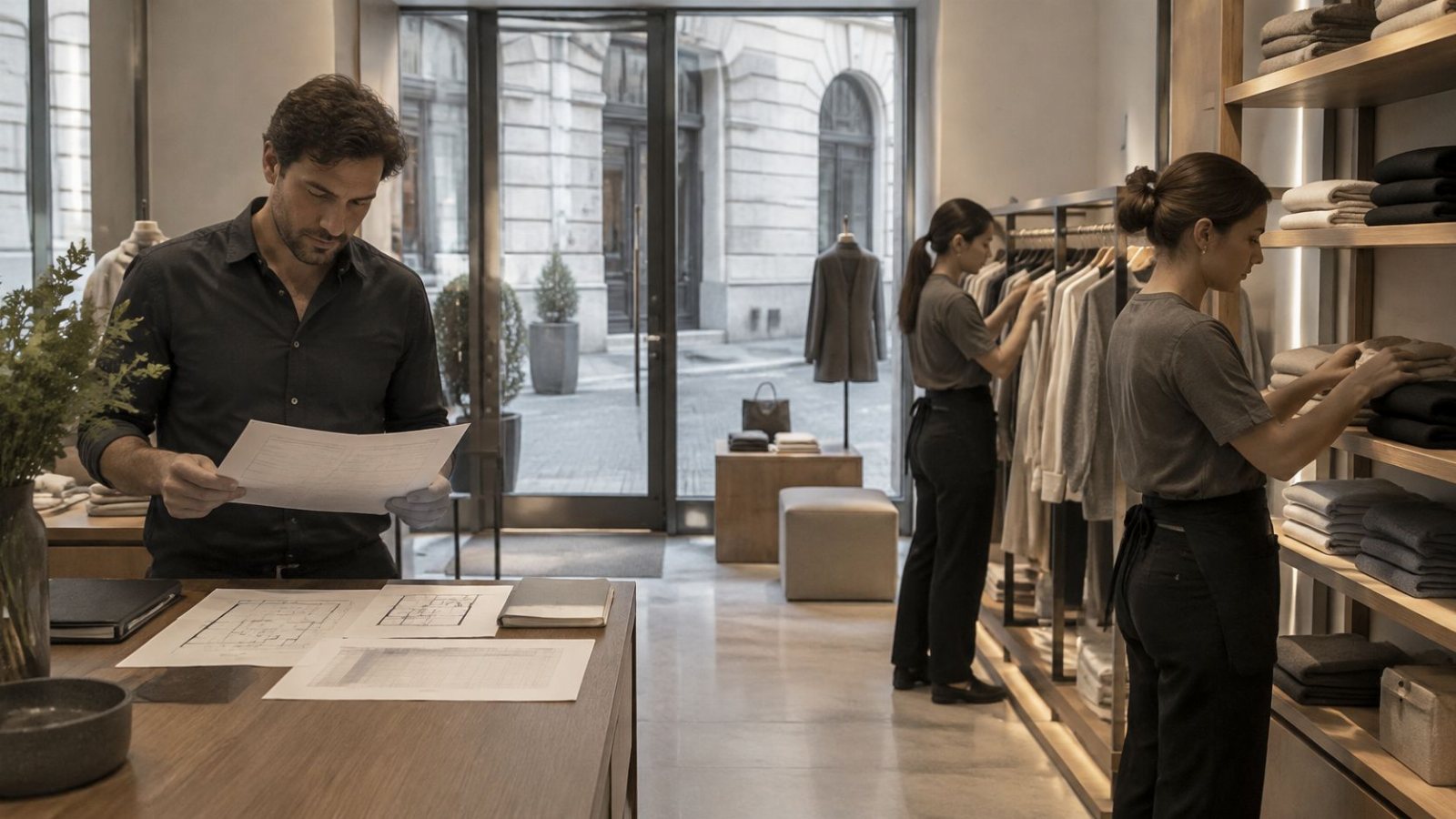
Compared with five years ago, three shifts matter more than any new software.
- The customer arrives informed. They have already seen price, alternatives, reviews and availability. They don't come in to discover, they come in to check and be reassured.
- The data exists, but it has to be checked on the shop floor. Sales and reviews say a lot; what happens in front of the shelf says the rest.
- The clientele is more varied. Alongside the neighbourhood regular there is the visitor of the fashion and design weeks, with a different language, pace and expectations.
A neighbourhood optician is a good test bench. People who come in have often already read about lenses, coatings and price ranges, and the manager's task shifts from explaining to checking: what they have understood, what they are missing, which test they really need.
The skills that set a good retail manager apart
Skills are recognised by behaviour in the store, not by job titles. The table compares what the manager does with the signal that shows whether that skill is there or missing.
| Skill | What the manager does | Signal in the store |
|---|---|---|
| Reading the customer journey | Understands what the customer has already seen on price, reviews and availability | The staff respond to people who come in already informed |
| Using data without being replaced by it | Queries sales and reviews, then checks the number on the floor | The data is confirmed or contradicted by observation |
| Handling several kinds of customer | Adapts welcome and timing between regular customers and international visitors | Service times stay stable at peaks |
| Getting the strategy carried out, with the reasons | Explains decisions, motives and means to the team | The service is mentioned by the staff and not asked about twice by the customer |
| Measuring conversion together with the receipt | Reads conversion, average receipt and observation together | Decisions on staff and range use more than one indicator |
The starting point is a figure: in 2024, 44.6% of in-store purchases in the Milan-Lodi-Monza Brianza area were guided by at least one digital touchpoint, according to Netcomm and Confcommercio Milano. It doesn't ask you to become a digital expert. It asks you to know what the customer read before crossing the threshold.
The two skills managers neglect most often are the least showy: checking the number on the floor and being able to adapt the register. The first is trained with ten minutes of observation in the middle of the day, the second with training on the human touch in retail.
Responsibilities towards head office, team and customers
Towards head office, the manager turns a strategy into something that can be carried out. When a memo arrives, the question to ask straight away is practical: how much time, what space, which tool are needed for it to become a service and not just a sign on the wall.
Towards the team, they are accountable for shifts at peak hours, short briefings before opening and training on the floor. The staff must be able to explain, not just carry out. Towards customers, they are accountable for welcome, complaint handling and picking up useful signals, such as the questions that come up three times in a week: those show where the customer journey breaks down.
The critical case is always the same. Head office decides on a service, for example in-store collection of online orders, and announces it with a memo. The team follows it to the letter, but at peak hours can't explain it. Two clues give it away: the sign is there and nobody mentions it, the service exists and the customer has to ask for it twice.
The fix starts with whoever decides, not whoever carries out: come to the store, watch the floor at the worst hour and ask the team what is missing. The manager, for their part, is also accountable for decisions taken on the data, so they must be able to justify them to head office.
The Milan context and why it changes priorities
In the third quarter of 2025, retail turnover in the Milan metropolitan area grew by 3.4% year on year, against 1.5% for Lombardy, according to the Milan Monza Brianza Lodi Chamber of Commerce.
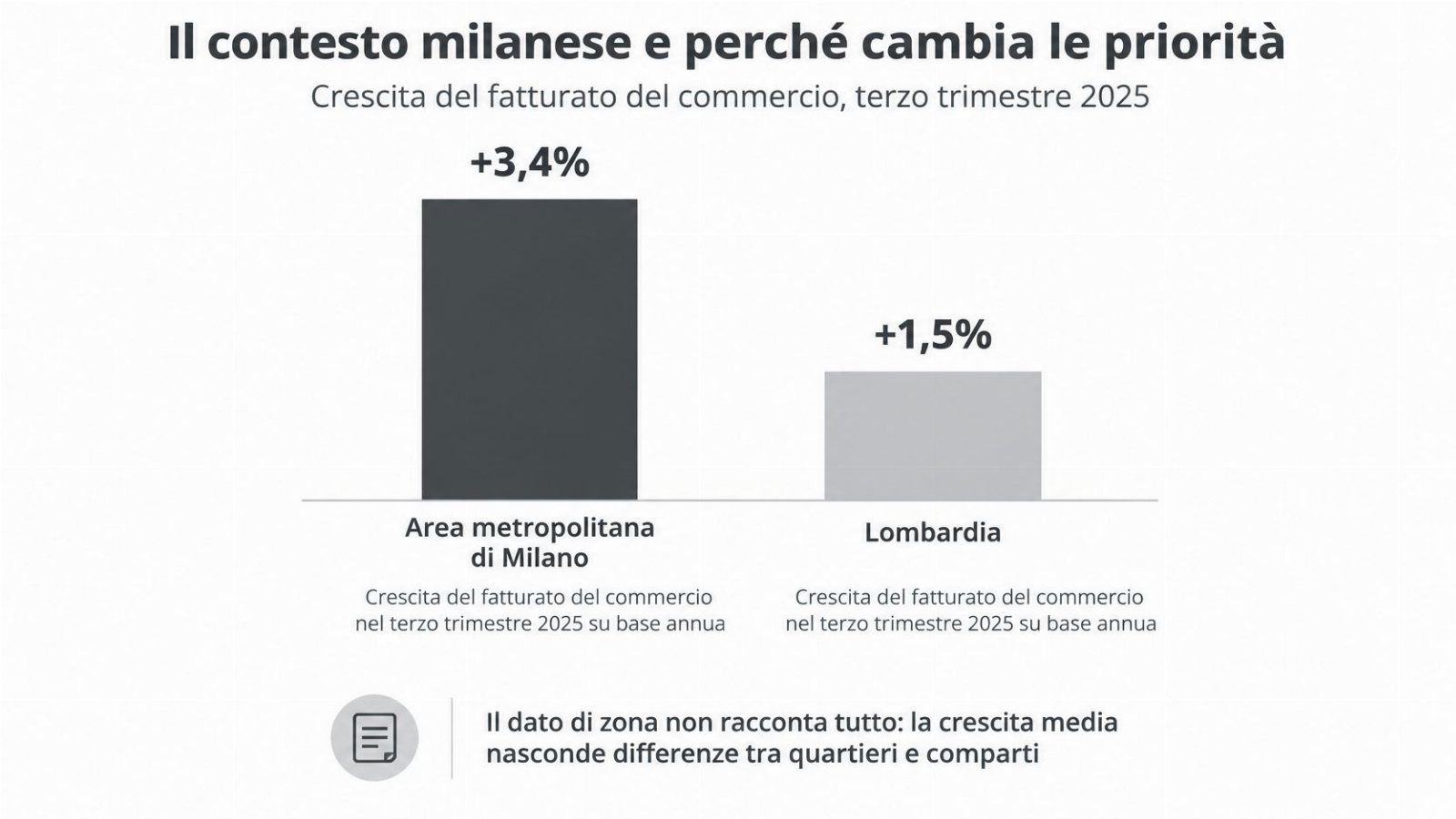
The figure doesn't say whether your store is more productive or whether the customer has a better experience. It may reflect prices, product mix and different flows between the centre, the neighbourhoods and large retail parks. This ambiguity gives rise to three city priorities: tell footfall and conversion apart, because a full store in the centre doesn't always sell; read the average receipt separately by area and by customer segment; keep an eye on service times, which weigh more when the clientele changes register.
Think of a home and living store on a busy street that grows in footfall but not in receipt value. The area trend is not a target: it is a benchmark for your format. Four indicators must be read together: footfall, conversion, receipt and service times. For work on Milan's districts, the Brera District case is also worth a look.
Where to train in Milan and how to choose a programme
Since 2 February 2025, Article 4 of Regulation (EU) 2024/1689 has required those who provide or use AI systems to ensure a sufficient level of AI literacy among the staff who use them, as summarised in this overview of the AI Act obligations for businesses. The law sets no universal number of hours and no standard certificate: the skills must be appropriate to the role, the context and the tools.
In the store, this also covers the AI features already inside the CRM, the customer service software or the writing tools. And when those systems process customer data, the GDPR remains the reference for collection and use.
Rule of thumb: before choosing a course, map the tools you use and who uses them. Training is documented, not improvised.
To assess a programme, four criteria matter more than the syllabus. The course starts from real stores and concrete problems. It includes practice on the floor, where the team tries the tools with customers. It states what it issues at the end, so it can be filed in the documentation. It offers a way to measure what changes afterwards, with indicators chosen before starting.
Milano Retail Tour (MiRT) offers MiRT Explore, AI Retail Tour & Academy, and it is worth applying these four criteria to its programme as to any other before deciding.
What to do from next week
- Make a visit outside your sector. Once a week, walk into a store in another sector with a notebook and a single question in mind. Observe three moments: the threshold, the encounter with the staff, the payment. Then ask something of the people who work there.
- Ask the team what arrives before the customer does. Have them tell you what information customers mention on price, reviews and availability, and update the floor plan accordingly.
- Read conversion and receipt together. The conversion rate on its own doesn't see the person who tries in store and buys online the next day.
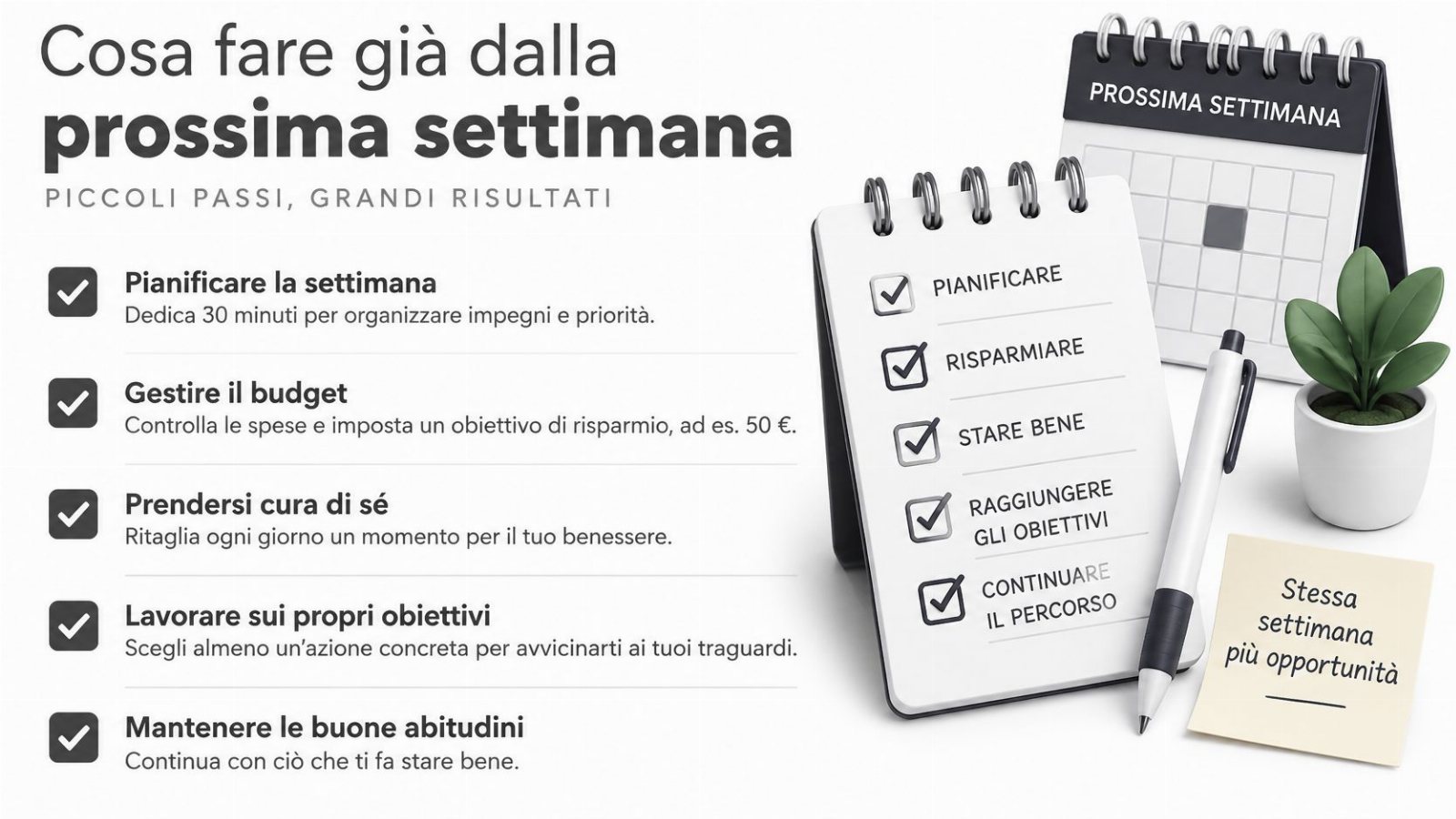
- Document the AI tools. Map the ones with artificial intelligence components, note who uses them and keep the instructions and records of the training given.
- Write down one thing to try. By the evening, note a single idea taken from the visit and put it to the test the following week. Without this step the visit stays a stroll.
If you want a method to get started, download the free guide and choose your first move. The role is judged by the ability to help the team work better with the right data.
To understand how to observe a store before deciding what to change, the video below goes with the method described in this article.
Sources: Confcommercio Milano and Netcomm, figure on 44.6% of in-store purchases guided by digital in the Milan-Lodi-Monza Brianza area, 2024; Regulation (EU) 2024/1689, Article 4; Milan Monza Brianza Lodi Chamber of Commerce, retail economic survey, third quarter 2025.
If you want to see first-hand how Milan's stores work, since 2011 Milano Retail Tour has been organising professional visits with a researcher at your side, designed for those who run one or more stores and want to turn observation into operational decisions. You'll find the tours and training activities, with up-to-date dates and formats, on the Milano Retail Tour website.