

 Italiano
 English
Published ·

Two sales assistants in a neighbourhood store are arguing in front of the window. A customer came in, looked at a bag and left. One says he had no budget, the other that nobody spoke to him. The owner suggests going together to two other stores to see how customers who don't buy are welcomed. Research based learning starts from that question, not from a definition. Here you'll find eight research based learning examples, with their limits stated and one applicable move for each.
Contents
- Eight research based learning examples, read from the store
- 1. Ethnographic field observation in stores
- 2. Inquiry-based science education: learning by asking questions
- 3. Problem-based learning: the clinical case as a starting point
- 4. Citizen science: non-experts as researchers
- 5. The case method: analysing real business decisions
- 6. Action research: studying a problem and changing it at the same time
- 7. Service learning: research on the problems of a local community
- 8. Market research carried out by students with real customers
- Comparing research based learning methods for retail training
- What to replicate on Monday morning in your store
Eight research based learning examples, read from the store
1. Ethnographic field observation in stores
Small groups go into real stores with three questions and a notebook, and note how people who come in are welcomed, how the brand is presented, where the sale breaks down. Back in the classroom the notes are compared and become hypotheses for your own store. This is Milano Retail Tour's Research Based Learning method: observe, interpret, apply.

The design that holds the work together has three phases: an initial survey, guided observation, and a final assessment on the same scale (University of Palermo case study on an inquiry-based workshop). Without the third phase it remains a site visit. And the yardstick is not how much people enjoyed it: in Italy only 13% of workers take part in professional training, one of the lowest shares among European economies (CNEL, paper on work and technology).
- Write three questions before you go: welcome, display, closing the sale. Three are enough.
- Keep facts and interpretations apart: "nobody greeted him" is a fact, "rude staff" is a hypothesis.
- Finish with a single action: one change that can be applied within two weeks.
Before the tour, the reading that frames the journey is the retail customer journey.
2. Inquiry-based science education: learning by asking questions
People who learn through inquiry start from a question, not a definition. The STEM guidelines of the Regional School Office for Lombardy describe a cycle of questions, hypotheses, experiments and checks, with students in an active role under the teacher's guidance. The value isn't in the observation itself, but in turning a concrete experience into a structured process of gathering and interpreting evidence.
The model has spread in Europe through the Fibonacci project, which brought it into schools as inquiry-based science teaching. In the store it becomes a comparable question: how does the welcome differ between a perfumery and a neighbourhood optician? Observers must gather consistent data, otherwise they are comparing impressions.

Three tips: start from a concrete case instead of the chapter on service, let the group propose the criteria before correcting them, and assess the workbook and the quality of the questions, not just the conclusion.
3. Problem-based learning: the clinical case as a starting point
Small groups are given a problem, often a clinical case, and must state what they know, what they don't know and what they need to look up. The literature search comes out of the problem, not the syllabus. The model is linked to the Faculty of Medicine at McMaster University in Canada, where Howard Barrows developed it between the 1970s and 1980s.
A useful problem has incomplete data. If it already contains the answer, the exercise is revision, not research.
In retail it works with a real, unsolved case: conversion dropping between 6 and 8 pm in a home and living store, with sales, footfall and staff rotas on the table. The group decides which information to ask for before proposing a solution.
Ask each team to state what new information would change their hypothesis, and keep the last quarter of an hour for reflecting on the process, not on the solution.
4. Citizen science: non-experts as researchers
People with no scientific training classify images and feed real databases. Galaxy Zoo, launched in 2007 and linked to the University of Oxford, is the best-known case: volunteers classified galaxies in a volume of data that researchers alone could never have examined. The platform that hosts it is Zooniverse.
In retail, the equivalent is spreading observation across several stores. The limit is the skill of those analysing: in Italy, basic or above-basic digital skills cover 54% of people aged 16 to 74, against an EU average of 60% (INAPP, analysis of digital skills). If everyone observes and nobody can read the data, the project stalls.

- Assign distinct roles: observer, interviewer, analyst, facilitator, checker.
- Define quality control in advance: who rechecks one sheet in ten?
- Share the aggregated results: those who collected the data must see what it says.
5. The case method: analysing real business decisions
Students read the reconstruction of a business situation with data, constraints and decisions already taken, and assess the alternatives. The method took hold in business schools starting with Harvard Business School, founded in 1908. The research doesn't consist of finding the correct answer, but of rebuilding the context and testing hypotheses against the information available.
The subject of the cases has shifted in Italian retail: 46% of the top players have integrated traditional AI into their business processes in a structured way (Politecnico di Milano B2c eCommerce Observatory). The most instructive case today is a badly taken automation decision, not a success story.
Build the cases from your own stores, with anonymised data and three alternatives at the end; ask which data is missing before deciding; compare the choice made back then with the one the team would make today. For an example of a changing context, see what changes in stores after Apple.
6. Action research: studying a problem and changing it at the same time
A group identifies an operational problem, studies it with data gathered in the field, tries out a change and measures the result. Then it repeats the cycle. Kurt Lewin formalised it in 1946 as a process in which research and intervention move forward together.
The documentation is there so you can run the same test again in six months, not to look good in the meeting.
Action research in Italian schools uses different tools for each phase: observation with structured sheets, listening through questionnaires and focus groups, monitoring, and a final reflection on the results. The documentation, according to material from the Regional School Office for the Marche, ensures the process can be understood and transferred.
An openly hypothetical example: a neighbourhood optician presents sunglasses in two different ways for three weeks and compares sales with the previous period.
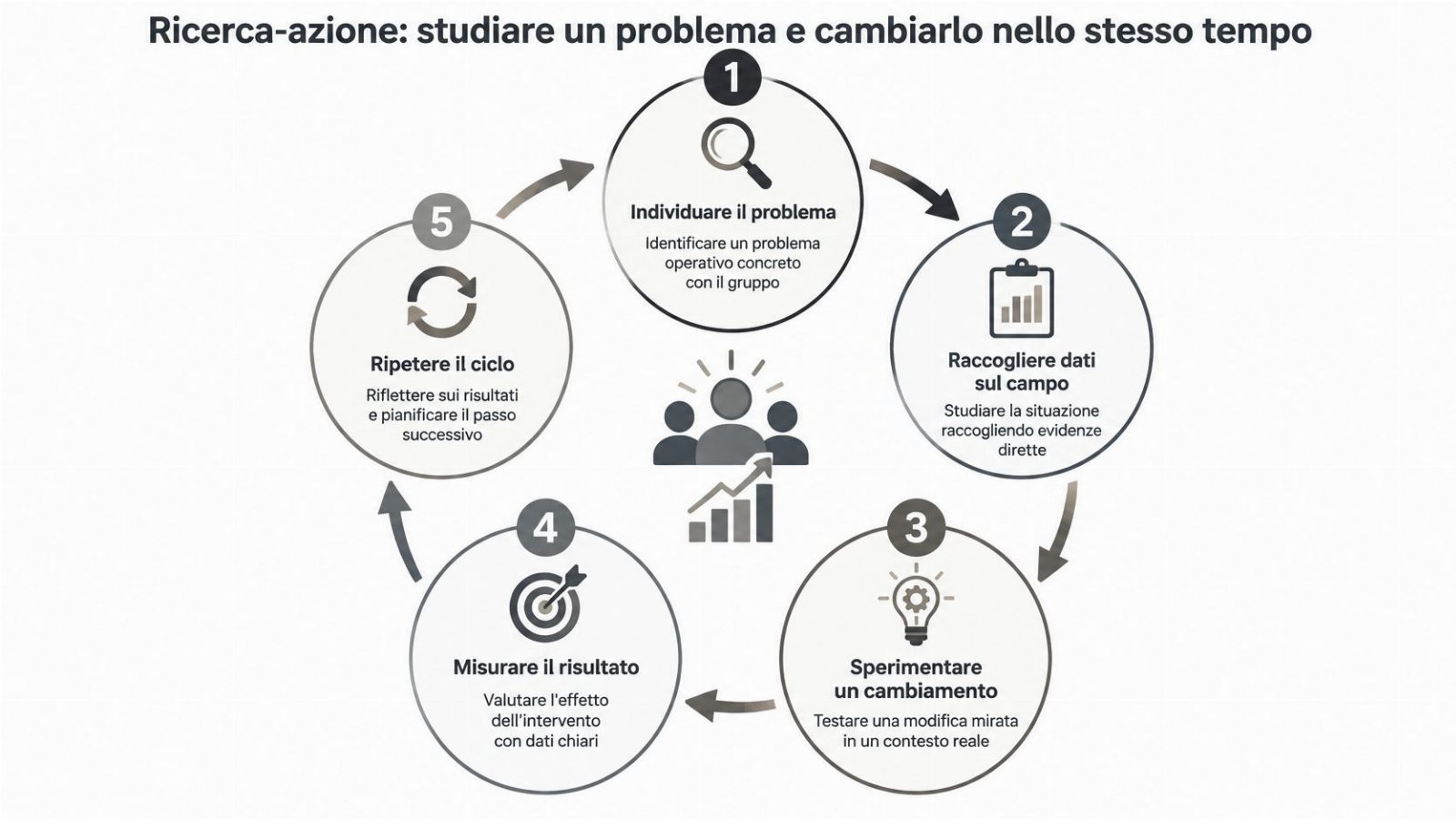
- One indicator per cycle: conversion on the display you are testing.
- One change at a time: two changes together don't tell you which one worked.
7. Service learning: research on the problems of a local community
Students work for a local body or association on a real problem that nobody has time to study. The result is a document useful to whoever commissioned it, plus learning that comes from being responsible to a client. The model is widespread in American universities and in some Italian third-mission programmes.
The typical client is small: in Italy, 8.2% of companies with at least 10 employees have adopted artificial intelligence technologies, against an EU average of 13.5% (AIDIA on ISTAT data). In a network of three stores, an in-house research department doesn't exist.
A hypothetical example: a business studies class looks at the accessibility of the shop windows on a shopping street on behalf of the traders' association and delivers a map of the problem points.
- Agree on how the result will be used before starting: who receives it, what they do with it.
- Keep the question narrow: a few weeks, a single problem.
- Plan a public presentation: it raises the level of care in the work.
8. Market research carried out by students with real customers
Saturday morning, two students stop customers at the door with a short questionnaire. At the end of the shift the manager reads the answers with them. The store gains evidence it didn't have before. The value depends on how clear the initial hypothesis is and on the client's access to the raw data, not just the final chart.
A marketing course can keep the scope tight: one question, collection on the pavement, a reading with whoever runs the store. For the owner, the move comes before the questionnaire. They decide first which choice the work must produce, whether price, display or opening hours, and match every question to that choice.
32% of Italian consumers say they use AI to make shopping easier (Adyen, Retail Report 2025). The question about how the customer searches for a new product should be written explicitly. A pre-post design with three separate indicators (accuracy in interpreting the evidence, quality of the recommendations, observable collaboration) separates what the students learned from how they felt during the data collection.
The sample must be defined before going out onto the street. The operational reference is how to define your target. Without that boundary, the answers mix regular customers and passers-by, and the report can't guide a decision on the range.
If the team uses generative tools to read the open answers, Article 4 of the European regulation on artificial intelligence places the AI literacy obligation on anyone who uses AI systems on behalf of the business. The owner states who checks the output and what remains a human decision.
- Write the hypothesis before the questionnaire: afterwards, it bends to fit the answers.
- State the method and the number of responses: without these two figures the report can't be checked.
- Finish with a decision about the store: not with a chart.
The owner can have the same sheet repeated on the next shift and compare the three indicators. If the recommendations don't change a choice about the shelf or the welcome, the questionnaire is not yet a staff training tool.
Comparing research based learning methods for retail training
| Method | Context of use | Main advantage | Main limit | Can be replicated in store |
|---|---|---|---|---|
| Ethnographic field observation in stores | Visits to real stores and group debriefing | Evidence gathered directly in the sales setting | Takes time and coordination | Yes, by observing welcome, display and selling |
| Inquiry-based science education: learning by asking questions | Science learning based on questions, checks and data | Develops evidence-based reasoning | Needs trained teachers and longer timescales | Yes, by adapting the method to concrete questions about the store |
| Problem-based learning: the clinical case as a starting point | Learning in small groups starting from realistic problems | Connects theoretical knowledge and practical application | Depends on the quality of the chosen problem | Yes, starting from the store's operational problems |
| Citizen science: non-experts as researchers | Research projects where volunteers collect or classify data | Widens the observation base | Needs quality control and data management | Yes, by collecting observations from several stores |
| The case method: analysing real business decisions | Discussing business situations and assessing alternatives | Trains judgement in complex situations | The case doesn't give the full context | Yes, using real store cases with anonymised data |
| Action research: studying a problem and changing it at the same time | Trying out operational changes and measuring the results | Produces verified change | Takes time and clear measurement criteria | Yes, by testing one change and measuring its effect |
| Service learning: research on the problems of a local community | Research projects for local bodies or communities | Produces work that is useful to the client | Needs a willing client and coordinated timing | Yes, by working with an association or a retail network |
| Market research carried out by students with real customers | Customer questionnaires and analysis of the results with the store | Provides recent data at low cost | The sample may not be very representative | Yes, by involving students and customers in a targeted survey |
What to replicate on Monday morning in your store
Before acting, choose what to observe and how to record it. Three questions are enough to define the work: how is the customer welcomed? How is the product presented? How does the sale end?
Try one change at a time in one department. Note the numbers available and the staff's observations, then compare them with the previous period. Close the comparison with a written decision, an owner and a review date.
To work out where to start, Milano Retail Tour offers the MiRT Diagnosis: a free 30-minute video call before you buy any tool. Milano Retail Tour organises professional visits to Milan's stores and workshops that turn observation into decisions you can apply in your own store.