

 Italiano
 English
Published ·

Three new reviews on the store's profile. One praises a knowledgeable sales assistant, one complains about the wait at the till, the third gives one star and says the prices on the shelves can't be read. The owner reads them one after another, looks at the average, 4.2, and does nothing.
The voice of the customer is the set of signals through which customers say what works and what doesn't, gathered systematically rather than as scattered comments. The point is not to have more of them. The point is to compare different channels, check the themes in the field, and only then decide what to change in the store.
Contents
- What the voice of the customer means for your store
- Where to listen to the customer and with which tools
- Measuring satisfaction without a single average
- Online reviews to read with caution
- AI tools for comments, always after the store's problem
- From complaints to priorities, with a plan for Monday morning
What the voice of the customer means for your store
In the afternoon a customer asks for a size that isn't on display and leaves without buying. In the questionnaire they may still say they were satisfied with the courtesy: the problem isn't the service they received, but what the counter failed to make visible.
For the store, the voice of the customer is this step from signal to verification. Reviews, regular observation on the floor, the post-purchase form and conversations with counter staff must all end up in a single collection point, where each theme is linked to a department, a time of day and a possible decision. Without this setup they remain isolated comments.
Over the last ten years, growth in Italian retail has been driven mainly by online, while small stores have struggled to keep up. The context describes the competitive pressure; it doesn't explain why a customer gave up in that particular store. For a chain of 1 to 15 stores, the comparison is not only with the brand next door, but also with how easy it is to buy online.

The measurable value lies in the ability to act on range, welcome, availability and the till. A theme becomes relevant when it recurs, has an observable cause and points to a decision to try.
Where to listen to the customer and with which tools
No channel is enough on its own. Each one sees a different part of the experience and gets things wrong in a different way, so the question is not which tool to buy, but which combination can support a decision.
| Channel | What it captures | Limit | Use in the store |
|---|---|---|---|
| Online reviews | Spontaneous opinions on product and service | Self-selected sample, possible incentives | Spotting recurring themes |
| Short interviews in store | Motivations and expectations | Limited time, small sample | Checking the causes of the themes that emerged |
| Field observation | Waiting, wayfinding, abandonment | Observer's subjective interpretation | Confirming structural problems |
| Post-purchase questionnaire | Satisfaction measurable over time | Response rate often low | Building comparable indicators |
| Chat and messaging | Recurring questions and response times | Visible only to those who use the channel | Finding information gaps |
| Conversations with staff | Frictions the customer doesn't mention | Internal point of view, to be cross-checked | Completing the data from the other channels |
Rule of thumb: a channel confirms or contradicts, it doesn't decide.
Picture a neighbourhood optician: the reviews talk about long waits. Observation in the store shows that the problem is a single counter open at peak hours. The review was right about the symptom, not about the cause.
An academic study on an international retailer analysed 80,910 reviews of stores in Italy collected between April 2016 and March 2017, validating them with around 800 in-store interviews and an online survey of 700 consumers (University of Verona research). The text of reviews is a high-resolution sensor, not a representative sample of the clientele.
You need a taxonomy of the moments in the journey (entrance, wayfinding, assistance, range, payment, collection, after-sales), like the one used in the customer journey guides, and every comment should be coded by theme, polarity, intensity and attributed cause. Chat, meanwhile, is also a listening channel: a study of the Italian customer experience market carried out in 2024 with Dynata finds that 70% of Italians mainly use chat and messaging in daily life (Indigo.ai, Customer Experience Unlocked 2024). Two caveats: in post-purchase forms and in chat, collect only the data you need, and tell the customer in writing how you use it. The GDPR doesn't forbid listening; it asks for a stated purpose and limited retention.
Measuring satisfaction without a single average
Two stores with the same average rating can have opposite problems: one concentrates its issues at the till, the other in the range. The average makes them identical; the distribution across levels doesn't. A scale that distinguishes three levels says more than a single number, and the Istat survey shows this clearly.
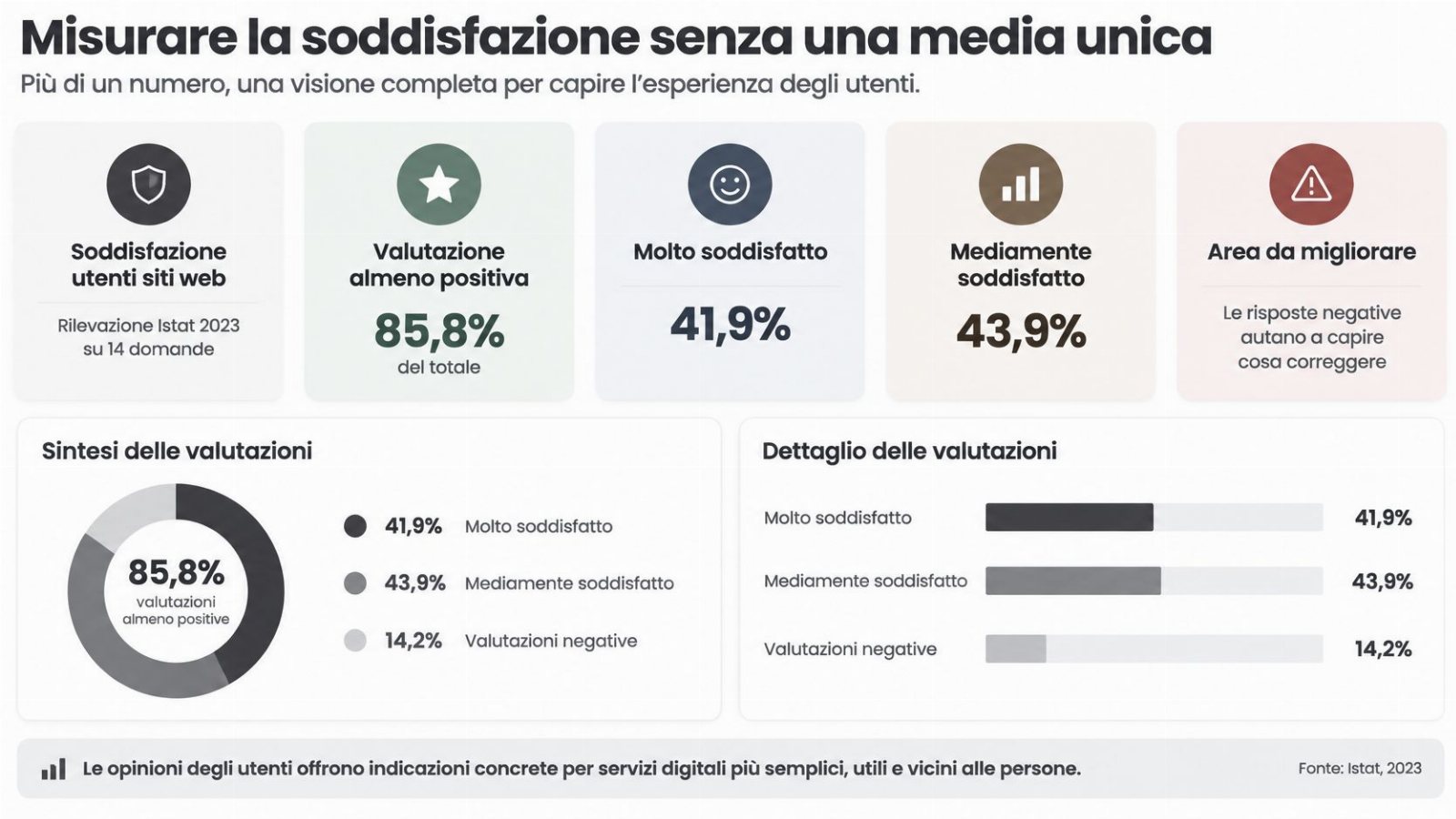
In the 2023 Istat survey on the satisfaction of users of its own website, carried out between 20 June and 20 September with a 14-question questionnaire, 41.9% said they were very satisfied and 43.9% fairly satisfied: 85.8% gave at least a positive rating, 14.2% little or not at all.
| Indicator | Share |
|---|---|
| Very satisfied | 41.9% |
| Fairly satisfied | 43.9% |
| At least positive (total) | 85.8% |
| Little or not at all satisfied | 14.2% |
| Data products, satisfied | 85.2% |
| Data products, dissatisfied | 14.8% |
Why the voice of the customer doesn't fit in an average
The results should be read by store, by stage of the journey and by type of customer. Istat measures users of public websites, not store customers: the figure is useful as a method for reading a distribution, not as a sector benchmark. In your store you don't need a universal threshold. Any visible share of dissatisfied customers calls for an analysis of the causes, not for collecting more comments.
More feedback doesn't raise the quality of listening. The value lies in comparing different channels and checking recurring themes in the field before deciding where to act.
Three indicators to define for each store: share of satisfied customers, average waiting time at the till by time slot, reasons for not buying gathered at the exit. How these indicators connect to service choices is described in the five pillars of the DMER experience.
Online reviews to read with caution
Reviews carry weight. 65% of consumers read them before buying online, 78% say they play an important role in their choice and 75% have posted at least one review or rating in the last two years (Altroconsumo survey on online reviews).
These numbers measure the weight of reviews, not the reliability of the average score. Extreme reviews, incentives, different expectations and differences between channels shift the average without the experience having changed.
A confirmed theme changes the store. A theme that exists only online changes the reply to the reviews.
The method that holds up is triangulation: take the recurring themes, look for confirmation in observation in the store and in conversations with staff, and separate confirmed themes from isolated ones. Picture a neighbourhood optician with many reviews about the careful packaging and a single one pointing out that the entrance is difficult for wheelchair users. That rare complaint weighs more than the others, because it is about access, not a preference.
In practice: respond to recurring themes more than to the single review, and compare the results with local competitors along the whole journey, from search to return.
AI tools for comments, always after the store's problem
Artificial intelligence is useful for coding hundreds of comments, drafting replies to reviews and reading sales data in plain language. It works when the problem is already defined: if you don't know which theme you want to measure, the tool produces elegant, useless summaries.
- Human review: the output is reread by someone who knows the store, not by whoever set up the tool.
- Personal data: comments contain names, contact details and purchase details, and must be handled under the GDPR with a clear purpose and limited retention.
- Training: those who use these tools must know what they do and where they go wrong.
On the last point the law is explicit. Article 4 of the European regulation on artificial intelligence has applied since 2 February 2025 and requires providers and business deployers to support the AI literacy of those who use AI systems on their behalf, at a level proportionate to skills, experience, role and context: no identical course for everyone, no standard duration (ANCE document on the AI Act). Before buying a licence it pays to understand where to start with AI in the store: the MiRT Diagnosis, 30 minutes on a free video call, is for exactly that.
The question to ask is just one: can your team tell a theme confirmed in the field from an automatic summary?
From complaints to priorities, with a plan for Monday morning
In food retail, the voice of the customer can be turned into a priority metric. Bain research reported by ESM Magazine finds that only 39% of Italian consumers are satisfied with the supermarket experience and identifies five critical moments that affect the likelihood of coming back; a satisfied customer spends more and visits more often, with sales up to 45% higher than disappointed customers (Bain research reported by ESM Magazine).
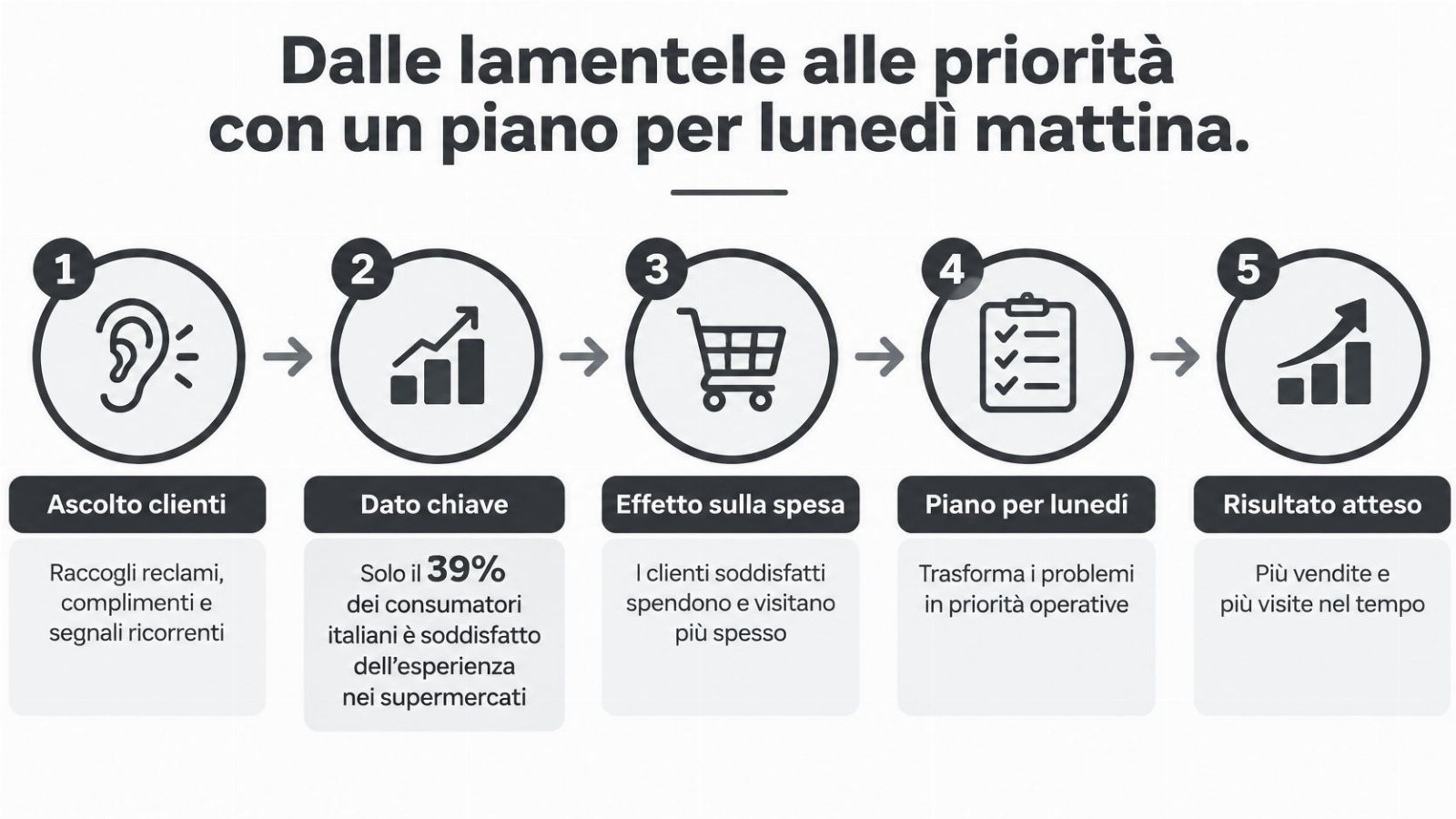
The figure says where to look, not what to fix in your store. The study's five critical moments are a market average: to know which ones are yours, you need a process that starts from real complaints and ends in a choice. Six moves are enough.
- Gather the signals in a single sheet. Reviews, post-purchase forms, chat, observation notes, staff notes. As long as they sit in five different places, nobody reads them.
- Code every comment by theme (wayfinding, range, till, welcome), polarity and intensity. A table with one row per comment is enough.
- Count frequency and severity by theme and by store: a rare but serious theme can weigh more than a frequent and minor one, and only separate counts show it.
- Validate the top three themes with two or three observations in the store and a conversation with the counter staff, because a written comment doesn't show the wait at the till or the empty shelf.
- Place the themes on an impact/effort matrix. What weighs a lot and costs little becomes a candidate; what weighs a lot and costs a lot goes into a separate plan.
- Choose one to three quick wins and assign a KPI to each: visit frequency, conversion, average receipt, repurchase. On Monday morning the plan is one line per action, not a summary of the feedback collected.
Each touchpoint needs four measures: satisfaction, stated importance, observed friction and repurchase intention. A theme that matters to the customer but has low friction is not a priority, and an obvious friction at a marginal step doesn't justify a project. Priorities also change from one catchment area to another: a national benchmark applied without checking in the field produces the wrong priority. The underlying limit remains: more feedback is not better listening. Without the step into the store, the analysis rewards those who write the most, not those who buy the most.
Sources: Confcommercio, data on retail sales and small stores 2015-2025 (via Ucapital); Istat, User satisfaction questionnaire results 2023; University of Verona, study of 80,910 store reviews in Italy (2016-2017); Altroconsumo, survey on online reviews; ESM Magazine, Bain research on satisfaction with grocery shopping in Italy; Indigo.ai with Dynata, Customer Experience 2024; ANCE, AI Act: what changes and AI literacy.
If you run one or more stores and want to turn customer comments into operational priorities, Milano Retail Tour has been observing Milan's stores since 2011 and takes teams inside them to see how welcome, range and the till become a measurable experience. You can download the free guide and start from the observation sheet. The tour calendar and the method are on Milano Retail Tour.