

 Italiano
 English
Published ·
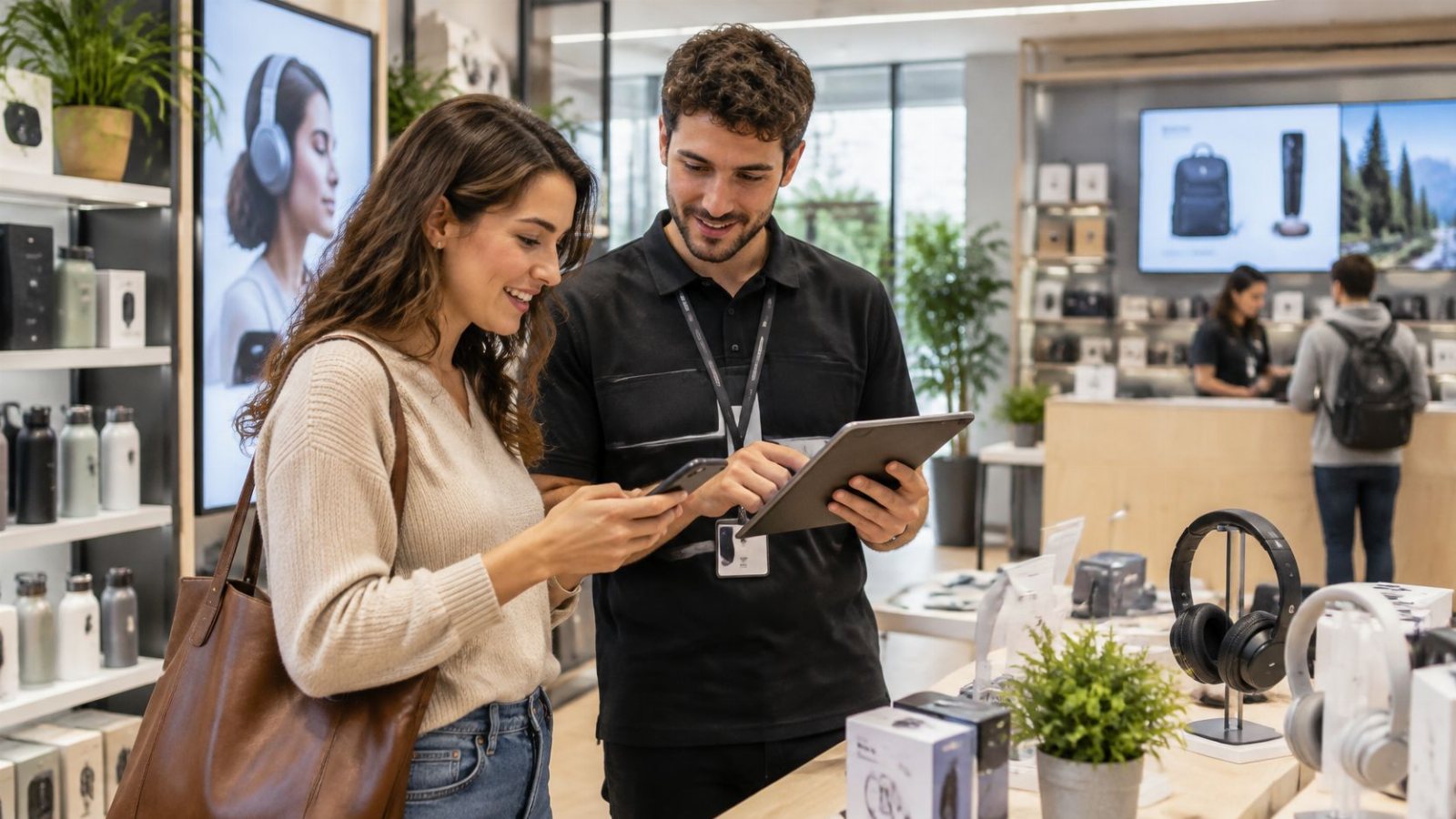
The customer arrives informed, the store remains. Eight retail trends read from the store's side, with the problem to solve before the tool.
The customer walks in, phone in hand, and asks whether that title also comes in another edition. They have already read the reviews, already compared the price, they know what they want. The store has a few seconds to give a useful answer, and the quality of that answer doesn't depend on the tool you have at the till. It depends on what you prepared beforehand.
The numbers help you understand the context, not solve the problem. In June 2024 the value of retail sales in Italy fell by 1.0% compared with the same month of 2023 and volumes by 1.8%, while large-scale retail grew by 1.4% in volume and small stores lost 2.0% in value (Istat, retail trade, June 2024). The market doesn't reward or penalise everyone in the same way: it favours those with scale, distribution capacity and a firm hold on recurring needs.
This article looks at eight retail trends from the store's side. For each one you'll find the problem to solve, the risk of tackling it badly and the first concrete move. None of the eight is a technological promise: they are things a chain of one to fifteen stores can start doing, or stop doing, without changing supplier.
Contents
- 1. The store as a pickup point
- 2. Clienteling via messaging, staff remain the channel
- 3. AI for product content, descriptions and answers
- 4. Virtual try-on and augmented reality on the shelf
- 5. Real-time inventory with RFID and stock data
- 6. Local reputation, between reviews and response
- 7. Experience and community, events that bring customers into the store
- 8. Traffic data and use of space in the store
- Eight retail trends compared
- What to do on Monday morning with these retail trends
1. The store as a pickup point
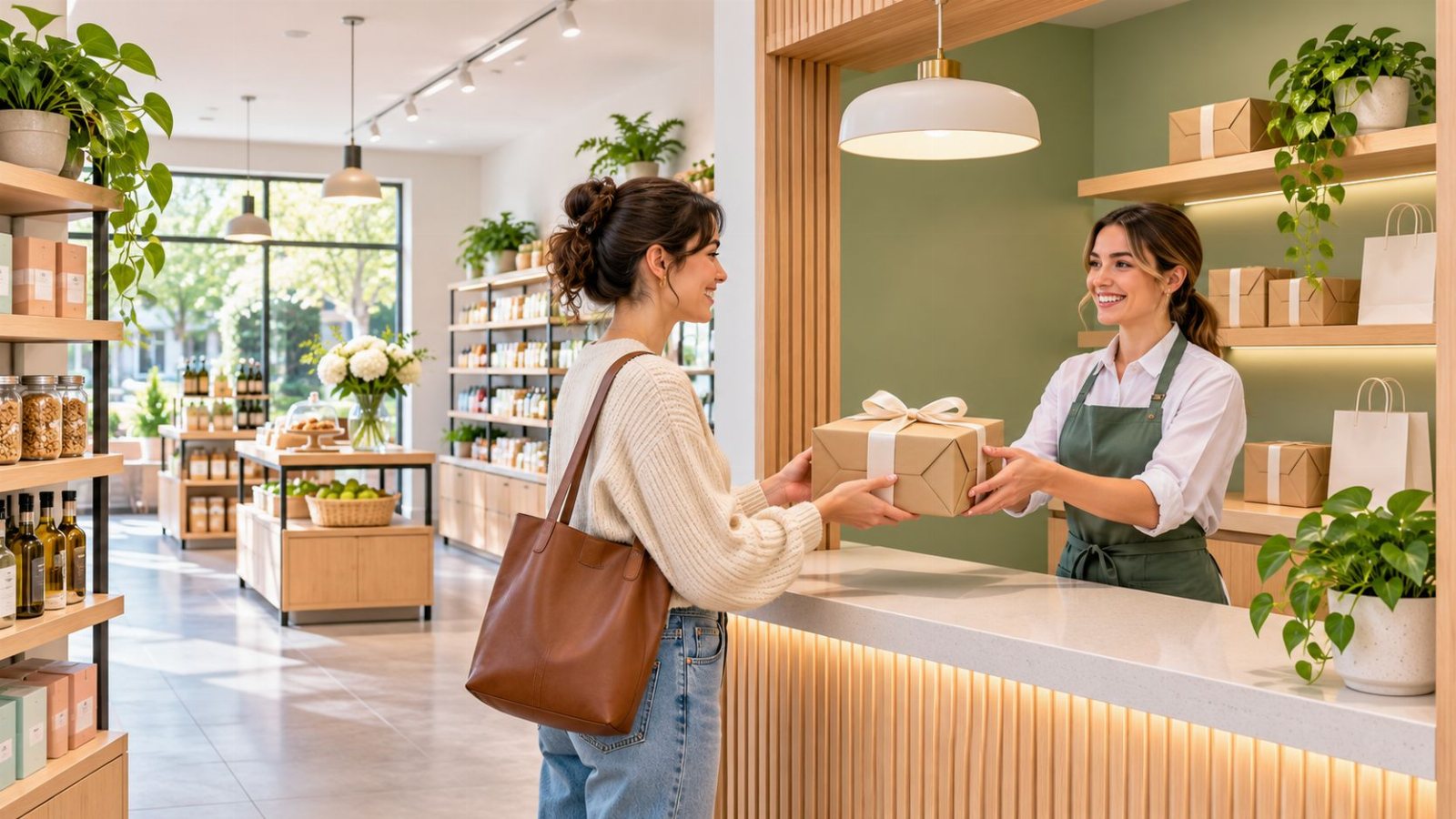
A parcel that arrives in the store is a person who comes through the door. If the pickup is over in thirty seconds at the till, that person has come in and gone out without seeing anything of the store. The advantage of click & collect isn't logistical: it's the extra step you can design.
The starting point is a figure on expectations. 85% of online shoppers would abandon their basket if they couldn't find their preferred delivery or returns options (DHL, E-commerce Country Report Italy 2025). It is usually read as a demand for faster couriers. For a neighbourhood store it means something else: the availability promise, timings, returns and assistance are one and the same experience, even when the purchase happens on site.
Where the add-on sale is lost
Pickup works when it has a beginning and an end, not when it's an errand. Picture a clothing store that reserves a rail and a side table for pickups, states a fixed preparation time and lets the customer know when the item is ready. Whoever comes to collect walks past the new arrivals, and sometimes stops.
Operating rule: if you can't say how many hours it takes you to prepare a pickup, the customer will find out for you.
State the maximum preparation time: write it in the confirmation message and stick to it on peak days too.
Separate the space: pickups and returns don't belong at the till, where people are queuing to pay.
Measure add-on sales: count how many customers collecting an order also buy something else, and compare the figure by category.
2. Clienteling via messaging, staff remain the channel

Clienteling isn't a newsletter under another name. It's the sales assistant writing to a specific person, for a specific reason, at a specific moment. The channel, WhatsApp or SMS, matters less than the reason: it works because the customer already uses that tool.
In terms of tools, the foundation is there. 60% of Italian retailers use a CRM and 33% a Customer Data Platform (Minsait, Digitization of customer relationships in retail, FMCG and fashion, Italy). The problem isn't collecting the data, it's deciding who uses it and when.
One message a month, not ten
The risk is turning the relationship into a promotional channel. A generic message is read as advertising, and unsubscribing is almost always final. Picture a neighbourhood optician who, with prior consent, lets customers with progressive lenses know when a frame compatible with their prescription comes in: same action, opposite outcome.
A relevant message opens a conversation. Four generic messages close it, and the customer who unsubscribes is often the one who used to buy.
Staff remain the channel of trust: the human touch counts for more than the channel you use. Three steps hold everything up: collect consent at the time of purchase with a separate question, assign each customer to a single colleague as their point of contact, keep contact to one message a month and measure unsubscribes the way you measure sales.
3. AI for product content, descriptions and answers
The incomplete product description is an old problem, and nobody has ever had the time to fix it. Generative AI cuts that time, but only if someone first decides which texts are missing and who checks them.
Adoption is already declared. In 2025, 35% of Italian merchants said AI had had a significant impact on their business model, and another 48% expected it to by the end of the year, for a potential of 83% (Emarsys, AI in Retail Report 2025). Actual uses, however, remain focused on content: content or image creation at 33%, data analysis at 27%, personalisation at 24%. Little or nothing on conversion, margins or on-shelf availability.
Who checks what goes out
Generated text is a draft, not publishable content: someone who knows the product has to correct details, materials, compatibility and tone. On top of this comes an obligation. The European AI regulation requires those who use these systems to ensure an adequate level of AI literacy among their staff, proportionate to the context of use (Regulation (EU) 2024/1689), and the obligation has applied since 2 February 2025.
Start from a list of problems: incomplete descriptions, photos without captions, repeated answers to the same question.
Appoint a reviewer for each category: every text goes through someone who has actually handled the product.
Train the team before scaling up: two hours on proper use are worth more than one extra licence.
If you're deciding where to start with AI in your store, the answer lies in the list of problems, not in the tool catalogue. A perfumery that prepares the descriptions for ten new arrivals in one morning and has them reviewed by the category manager has already won its week.
4. Virtual try-on and augmented reality on the shelf
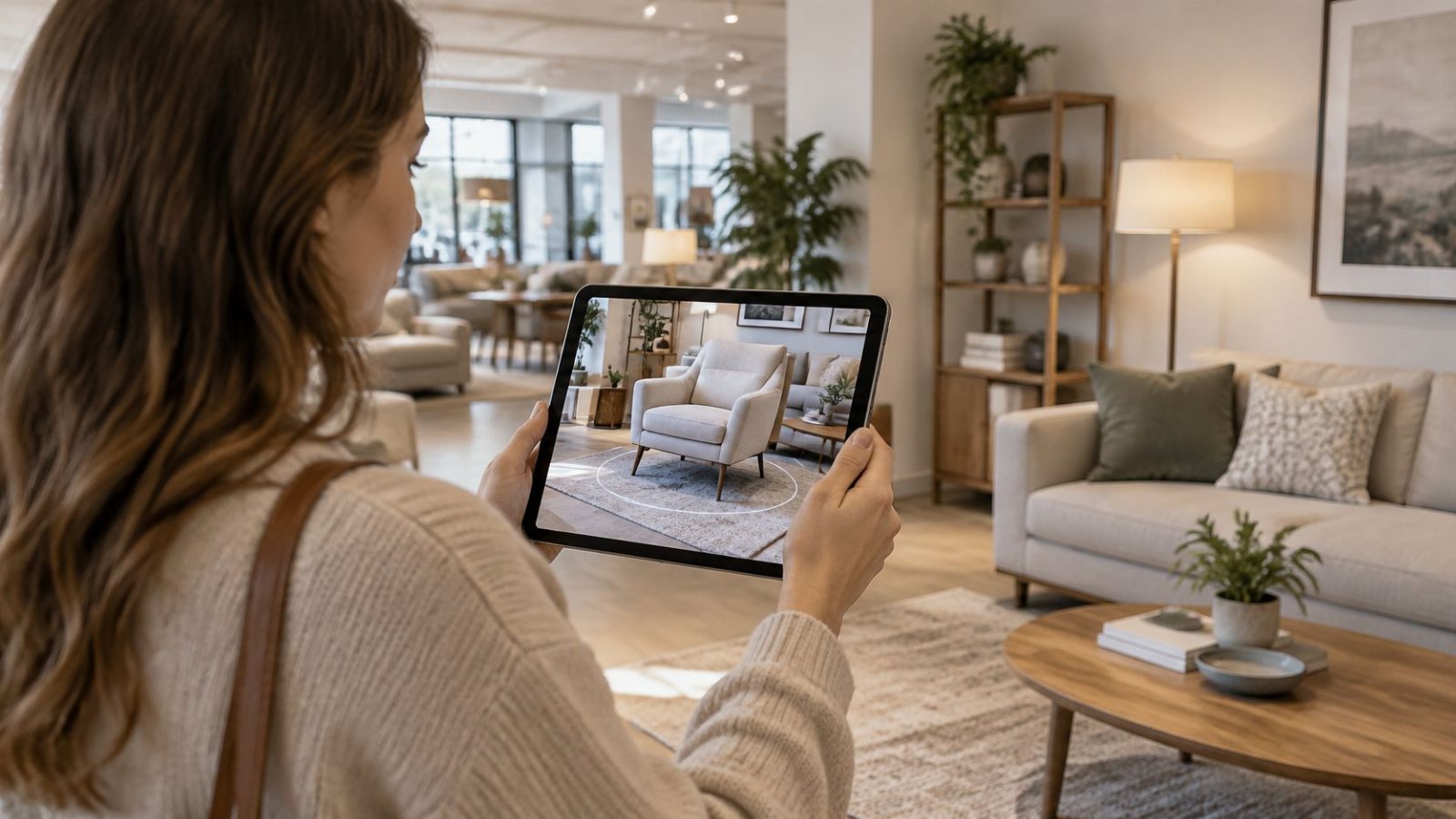
Augmented reality is useful when the customer can't try the product: a piece of furniture to see in the living room, make-up to see on the face, a colour that changes with the light. It doesn't replace trying on, it settles a doubt that trying in the store can't settle.
The pressure comes from categories that are already compared online. For 2025 a 6% increase in furniture and home eCommerce was forecast (Osservatori Digital Innovation, School of Management del Politecnico di Milano). Anyone selling home and living no longer competes on physical presence alone.
A well-known case points the way. Sephora developed Virtual Artist, the virtual make-up try-on available in its own app.
When the try-on isn't needed
Augmented reality doesn't sell. It removes a doubt. If the doubt isn't size, colour or space, it's of no use at all.
Choose the right products: only those where size or colour is the real obstacle to purchase.
Keep try-on, price and availability together: on the same screen, otherwise the customer leaves the app to search online.
Train staff to guide the try-on: a sales assistant who watches in silence leaves the customer alone in front of a tablet.
5. Real-time inventory with RFID and stock data
RFID, radio-frequency identification, puts a chip on every garment or product and lets you read stock levels without counting by hand. For the store it means something simple: knowing what's on the shelf and what's in the stockroom, with a stock count that's done in minutes instead of overnight.
The benefit isn't the count, it's the errors that disappear. A wrong stock figure causes two opposite kinds of damage: the lost sale on a product that showed as out of stock, and the double reorder on a product that was already in the back room. The Inditex group, owner of Zara, uses RFID across its entire range to control stock in its stores, and this is why.
Where to start without redoing the whole store
The investment makes sense for wide ranges and high turnover. On a category with few items and slow turnover, the return doesn't come and staff pile up one more step at goods-in.
Start with a fast-moving category: measure the return on that one before extending tagging.
Decide who tags at goods-in: a named person, not "whoever's free".
Compare read and book stock every month: the discrepancies are the real indicator of process quality.
Inventory data becomes useful outside the stockroom too: if you read it together with online availability, in-store pickup stops being a promise at risk.
6. Local reputation, between reviews and response
For a neighbourhood store, reviews are the first contact, often before anyone walks in. They get read sporadically, once a month, usually after a nasty surprise. The trend isn't collecting more of them: it's reading them by theme.
The regulatory framework is clear and worth knowing. EU Directive 2019/2161 prohibits presenting fake reviews as genuine, which closes the door on any shortcut. The response, on the other hand, remains an opportunity: the voice of the customer is worth more than an average score, because it shows which process to change.
Read by theme, not by stars
Picture a neighbourhood pharmacy that, by classifying its reviews, discovers that the wait to collect prescriptions comes up in three cases out of ten. The problem isn't courtesy at the counter: it's the staffing hours. Change those, and the theme disappears from the following reviews.
Classify by theme: waiting, expertise, availability, quality, returns.
Count the recurrences: three reports on the same theme are a process, not one unhappy customer.
Reply within one or two days: with a concrete reference to the case and no stock phrases.
To avoid: asking for reviews in exchange for a discount or a free gift. The practice is prohibited and the risk isn't worth the score.
7. Experience and community, events that bring customers into the store

The physical store still holds most of the spending. For 2025, Italian B2C eCommerce was estimated to exceed €62 billion, up 6% on 2024, but with online penetration of retail consumption stuck at 11.2% (Osservatorio eCommerce B2C, Politecnico di Milano). The rest still goes through a door that opens.
The risk is turning the store into an events hall for events that don't bring sales. The criterion is the link with the range: an event that doesn't touch the products on the shelves is entertainment, not retail.
One event a month, with a clear link
Picture a neighbourhood bookshop that holds a monthly meeting with a local translator, with the selection of translated titles displayed in the event area. Customers come back for the evening and often buy out of affinity with the place, not because of a discount.
Choose just one event a month: consistent with the range and with your staff's expertise.
Measure the following week: compare sales with the average of the weeks without an event.
Collect contacts with consent: to invite participants to the next one, not for a generic list.
8. Traffic data and use of space in the store
People counters and heat maps tell you where customers stop, which areas they walk through and at what times the store is full. They help you decide the layout of the counters, staff coverage and opening hours. They don't tell you why someone turned on their heel in front of a shelf.
That's the whole limit, and it needs saying before you buy sensors: the data measures footfall, not intention. To interpret it you need direct observation, with a notebook and a week of notes.
The data tells you where, not why
Picture a furniture store that, having seen that footfall in front of the counter peaks in the early afternoon, moves the sofa area towards the window. The decision comes from the data, the check comes from observation: if nobody sits down, the problem was something else.
Work on aggregated data: by area and time slot, without identifying individual customers.
Check with a week of direct observation: before declaring that the data means something.
Change one element at a time: and measure the effect before moving on to the next.
Even people counting can relate to identifiable individuals. State on the information sign what you measure, why and how long you keep the data, as the GDPR requires.
Eight retail trends compared
| Trend | Area | Main advantage | Critical point | First step |
|---|---|---|---|---|
| The store as a pickup point: click & collect and in-store returns | Omnichannel logistics | Brings customers into the store and cuts delivery costs | Queues and stockroom tasks can take time away from selling | Set preparation times and a dedicated space |
| Clienteling via messaging: staff remain the channel | Customer relationships | Encourages return visits with relevant messages | Intrusive contact or contact without consent damages reputation | Collect consent and assign each customer to a point of contact |
| AI for product content: descriptions, social media and answers | Content creation | Cuts the time spent on writing | Texts may contain errors or come across as impersonal | Identify a concrete need and appoint a reviewer |
| Virtual try-on and augmented reality on the shelf | Experience and advice | Helps the customer assess the product and reduces doubts | Costs and complexity of use can limit adoption | Choose products where colour or size holds back the purchase |
| Real-time inventory with RFID and stock data | Stock management | Improves the reliability of stock figures and speeds up stock counts | Investment and accurate tagging processes are required | Pilot on a fast-moving category |
| Local reputation: reviews, sentiment and response | Online reputation | Brings recurring problems to light and shows attention to customers | Hasty replies or inauthentic reviews damage trust | Classify reviews by theme and reply with care |
| Experience and community: events and services that bring customers into the store | Events and local communities | Increases visit frequency and strengthens the relationship | Events unrelated to the range absorb resources without generating sales | Organise one event a month linked to the products |
| Traffic data and use of space: people counters and layout | Store analytics | Supports data-based decisions on layout and shifts | The data shows where customers go, not why | Use aggregated data and check it through direct observation |
What to do on Monday morning with these retail trends
Eight trends, one criterion. None of the tools described solves a problem you haven't yet named, and none of these changes rests on a purchase: it rests on an assigned responsibility and a measure.
The temptation, faced with a list like this, is to start with the most visible. That's the wrong order. A people counter installed without a hypothesis produces a chart nobody looks at; a clienteling routine without consent produces unsubscribes; an event with no link to the range produces photographs. The store that holds up isn't the one that adopts the most tools, it's the one that adopts a few and connects them to day-to-day operations.
Before choosing a trend, three questions.
Which store problem does it solve, and how do I measure it today? If you don't have a starting number, you won't have a finishing number. The sale lost for a missing size, the average time to prepare a pickup, the number of reviews on the same theme: these are measures you can take this week, without buying anything.
Who looks after it every day, by name? A project without an owner becomes something done when there's time. That person must also have the authority to stop it if it doesn't work.
How is the result measured, and after how long do we look at it? A month is too little for an inventory, it's enough for a clienteling message. Set the deadline before you start, otherwise every outcome will look like a success.
The criterion stays the same, and it applies to all eight: first the problem, then the tool.
If you want to start here, download the free guide: for each trend it sets out the first move to make in the store and the measure to take before changing anything.
Sources: Istat, Retail trade, June 2024; Minsait, Digitization of customer relationships in retail, FMCG and fashion sectors, Italy, 2024; Emarsys, AI in Retail Report 2025, September 2025; DHL, E-commerce Country Report Italy 2025; B2C eCommerce Observatory, School of Management, Politecnico di Milano, 2025; Digital Innovation Observatories, School of Management, Politecnico di Milano, 2025; Regulation (EU) 2024/1689 on artificial intelligence; Directive (EU) 2019/2161.